Thursday, 12 July 2012

The incomprehensible Higgs!

For the last week, friends have been asking me about the seemingly incomprehensible Higgs revelation and what it means.  I've tried to admit to them that I really don't know enough to contemplate understanding the issues involved.  I have asked colleagues at work who are much better physicists than I ever aspire to be.  "What do you make of all this Higgs business?"  Most of them are in the same state as me, and feeling equally guilty about it.  Most agree that the scientists at CERN have been unusually unsuccessful at explaining why so much money has been spent on their project.

As it happens, I don't think £10 billion is a lot of money (on the grand scheme of things, compared with banks, oil rigs and the 'Nolymics') and I don't think it has been spent unwisely either.  So - I'll have a go at explaining the topic of the Higgs with my usual kitchen analogies.  They work very well when trying to explain fusion to non-technical people.  Wish me luck!  Its not that I'm superstitious, you understand!  It is just outside my normal area of experience to try to explain this topic.  Depending on how this goes, I might update it to incorporate other helpful analogies and metaphors that you, my dear readers, might provide.

Initially I'm going to cheat and plagiarise a little(Perhaps I should say 'quote' rather than 'plagiarise'?)  In 1993, the UK Science Minister, William Waldegrave, issued a challenge to physicists to answer the question 'What is the Higgs boson, and why do we want to find it?' on one side of a single sheet of paper. The winning entry starts like this . . .

"Imagine a cocktail party of political party workers who are uniformly distributed across the floor, all talking to their nearest neighbours. The ex-Prime Minister enters and crosses the room. All of the workers in her neighbourhood are strongly attracted to her and cluster round her. As she moves she attracts the people she comes close to, while the ones she has left return to their even spacing. Because of the knot of people always clustered around her she acquires a greater mass than normal, that is she has more momentum for the same speed of movement across the room. Once moving she is hard to stop, and once stopped she is harder to get moving again because the clustering process has to be restarted."

I think I need to take one step back.  What is mass?  Non-scientists find this difficult.  In terms of kitchen physics, mass is weight.**  In the analogy above, you can see that Mrs Thatcher effectively gains weight from the cluster of people around her.  Being 'heavier' it is harder to get her moving again if she stops, just as a wheel barrow full of gravel is harder to move than an empty barrow.  (Sorry for moving from the kitchen to the garden!)

Those clustering people do not represent the Higgs boson - the so-called 'God particle'.  We'll come to that later.  They represent something called the 'Higgs field'.  Now I need to explain what a field is.  In kitchen terms I can do that by asking what happens when you drop something.  It falls to the floor because of the Earth's gravitational field.  It is something intangible but undeniable.  Stop believing in this field at your peril.  Without the gravitational field that attracts you to the Earth you would float off into space.  If you ignore it you'll be surprised when you fall and hurt yourself.  The force of gravity comes from the interaction of mass with the gravitational field.  (Sorry - I have to use the word mass here instead of weight, but if you don't know the difference please ignore that.)

Since this is a difficult concept and I promised kitchen physics, cast your mind to fridge magnets.  Magnetism is the result of another field.  Magnets attract or repel each other because of a magnetic field.  No particles are involved.  The North pole of a magnet attracts South poles (and fridges) but repels other North poles.  We have all played with magnets and been amazed by the powerful effects of a magnetic field.  So without realising it, we intuitively know what a field feels like.

A few decades ago, Peter Higgs and a few others realised that mass (or 'weight') could actually be explained if there was another kind of field in the universe.  This field has been called the 'Higgs Field'.  Nobody knew whether it existed or not.  It was just a really good explanation of the observable facts.  The big question was whether it could be shown to exist.

The way that this can be demonstrated is by looking for a particle that is associated with the Higgs field.

Tomorrow - Why is the 'God particle' relevant to me?  I'll try to explain where the Higgs particle comes into the picture.

Meanwhile perhaps someone can tell me what this has to do with God?  The biggest mystery to me is the source and rationale for the ridiculous name "The God Particle".


**Actually, strictly speaking, what we think of as a weight of 1kg is really the force that the earth's gravitational field exerts on a mass of 1kg.  But that's just scientific pedantry to show to other semi-scientists like me that I know!


Wednesday, 11 July 2012

Take two apples . . .

One of the age-old questions is:

"Take two apples from three apples.  What do you have?"

What are the possible answers to this question?  Surely it is just obvious isn't it?

See the comments below for some possible answers.  Maybe you have some better answers.

Tuesday, 10 July 2012

Shakespeare's Surprising Psalm

Some people claim that William Shakespeare assisted with the poetry of the psalms when they were translated for the King James Bible.

Their evidence rests on an interesting coincidence - or else Shakespeare secretly embedded his name in a psalm.

It is a surprise to find that the following is actually true.  If you go to psalm 46, and count from the beginning, the 46th word is 'shake'.  Counting back from the end, the 46th word is 'spear'.

See for yourself.  Psalm 46:
  1. God is our refuge and strength, a very present help in trouble.
  2. Therefore will not we fear, though the earth be removed, and though the mountains be carried into the midst of the sea;
  3. Though the waters thereof roar and be troubled, though the mountains shake with the swelling thereof. Selah.
  4. There is a river, the streams whereof shall make glad the city of God, the holy place of the tabernacles of the most High.
  5. God is in the midst of her; she shall not be moved: God shall help her, and that right early.
  6. The heathen raged, the kingdoms were moved: he uttered his voice, the earth melted.
  7. The LORD of hosts is with us; the God of Jacob is our refuge. Selah.
    Come, behold the works of the LORD, what desolations he hath made in the earth.
  8. He maketh wars to cease unto the end of the earth; he breaketh the bow, and cutteth the spear in sunder; he burneth the chariot in the fire.
  9. Be still, and know that I am God: I will be exalted among the heathen, I will be exalted in the earth.
  10. The LORD of hosts is with us; the God of Jacob is our refuge. Selah. 
Numerology is everywhere!

Small note:  'Selah' is sometimes translated as something like the more familiar Alleluia, if that makes more sense.

Monday, 9 July 2012

Index Librorum Prohibitorum - questions for Catholics


Many of us are disturbed by the Roman Catholic church's strangle-hold on much of Christianity, and its effect on the lives of all who live in countries with even a few Catholics, like here in England.  You might ask what effect such a minority can have, but you should rest assured that it infuses government.  The present Prime Minister is not a Roman Catholic, but Tony Blair was - and worse still he was a Catholic convert.  Those who are converted to a different viewpoint are often the greatest zealots - much as I have taken the opposite view and spend a lot of writing against religions of all flavours.

However much they may deny that their faith has affected their political views, this claim simply must be in doubt.  Science is now strongly indicating that everyone always starts from what they believe and then finds ways to rationalise those views to minimise their own cognitive dissonance. 

A few times recently, I have taken up the challenge suggested by Richard Dawkins.  At a barbecue that I attended, I found myself speaking with a lady who came from the town where my father was born.  In the first ten minutes of conversation, she had told me twice that she had converted to Catholicism when she got married, and had brought up her children accordingly.

Each time I hesitantly hinted that I had parted from Christianity, and that it had been largely thanks to the overtly Catholic activities of our previous Anglican vicar in my village.  Usually I use the phrase "These days I'm a member of the church of Richard Dawkins" and watch for the reaction - which is commonly the smile that I aim to get by making that comment.   She seemed not to be offended - a good start - and a after I had answered a few questions about the subject I asked whether I might venture 'the Richard Dawkins question'.

"Do you actually believe in transubstantiation?"

Now this is a question that I have asked of colleagues who come from various 'Catholic countries' from Poland to Portugal.  I'm glad to say that all of them still speak to me, because if I found that they were avoiding me because of my questions then I would have to stop asking them.

My mother has asked it of Roman Catholic friends too and she reports that their answers show that they seem to regard their faith as a religion of convenience. 

The answer I got at the barbecue fell very much into the normal catalogue of possible responses to any of 'the difficult questions' which include:
  • Well - everyone's journey of faith takes them in different directions.
  • That is not actually one of the teachings of the church [Oh yes it is!] 
  • In our country we look to the church for guidance, not for absolute rules
  • The bible tells us that . . .  [and usually it doesn't]
  • That is left very much to our own conscience.

I've been wondering what other questions might be lined up for Catholics.  Some of them are obvious, but not necessarily the type of question you would ask people unless you know them well.  To each of these I have heard variants on the above replies.  What are your views about birth control?  Do you think the church should tell lies in African countries, saying that condoms cause AIDS? Is the pope infallible?  Why are you more likely to pray to Mary and the Saints before you pray to Jesus?  And do you agree that the pope is criminally liable for covering up crimes against innocent children and failing to cooperate with police?

Here is one that I have never yet asked.  "The Index Librorum Prohibitorum was only 'repealed' within the last half-century.  If you had had chance to read any of the literary works that were forbidden by the Index, would you have taken an interest?"

The Index Librorum Prohibitorum is/was a list of works that, in the view of a bunch of hysterical, elderly, male virgins, might adversely affect the morals of the ordinary people.  The Roman Catholic church must have wanted to keep the world's immorality within the church itself, and it has to be said that although it has failed, it has at least fostered extreme immorality in its own ranks without revealing enough about it to the rest of us.

The Index was only abolished by the Vatican in 1966.  Some say that a form of censorship is still in place, in that the Vatican libraries store many ancient manuscripts that can't easily be found elsewhere.  Putting these documents in the Index would have got them on the radar.  Leaving them off, they might disappear into obscurity and anonymity and never be allowed to cause embarrassment.

Fortunately there is already enough evidence to embarrass the church, and the bible itself is a good foundation for that evidence.

"The Old Testament is responsible for more atheism, agnosticism, disbelief - call it what you will - than any book ever written; it has emptied more churches than all the counter attractions of cinema, motor bicycle and golf course." -- A. A. Milne (author of Winnie the Pooh).

Any more questions for Catholics?

Sunday, 8 July 2012

Sunday Selection 4

Continuing a new series where there is little additional content from me, but I simply share a few items, new and old, that have pleased me this week.  As almost every week, I see items on the web that I find interesting, amazing or  or amusing.  This disjointed ramble might be on any of my normal topics - or on other topics entirely.  My thanks go to the friends who helped me to find them.

First:  'Hotwheels double loop dare' - although one son tells me that 'everyone has seen this, the other one hadn't.


Next: I just love the tango used in Arnie's humorous movie, True Lies.  The Movie version is here, and another version of the whole of Carlos Gardel's beautiful, passionate Por Una Cabeza can be found here.  Just seeing that makes me want to watch the movie again - worth a good smile!

Podcast of the week:  Radiolabs Podcast 'Talking to Machines'
Maybe some of us find ourselves talking to machines without realising it.  This podcast from June 2011 had some interesting surprises.

Atheist blog post of the week: Dear Atheists, We Ex-Muslims Are Waiting For You”, from The Friendly Atheist.  I think you can follow my 'Creeping Islam' tag to see that I'm supporting his campaign to some extent, at least.

Physics of the week: This has to be the announcement of the discovery of the Higgs boson.  You can't have missed that.  Here's Lawrence Krauss's take on it.  The question is - what does it mean?  I feel that this is too difficult a concept to explain in terms that we can all understand and since I don't get it myself, I'm not going to try.

Parody of the week:  Homeopath to start offering ‘assisted-suicide’ remedy.
" . . . as proof of its effectiveness, last week a man came in having a heart attack. The remedy was so good that he died before we could administer it.’  Read on and laugh out loud

Controversial atheism site of the week: Somehow, the most religious people in Israel seem to think they are too pious for the army, and yet they expect the more secular Israelis to risk their lives on their behalf. 

And finally . . .

Favourite places: Fingal's Cave

Fingal's Cave, Staffa, other end of Giant's Causeway
Fingal's surprising cave on the island of Staffa.


Saturday, 7 July 2012

Things Christians say, part 23: The banana

A weekly series of responses to the things Christians say to atheists, based on the video reproduced here on 30th January 2012.  The aim is to tackle one every weekend, to give both a moderate, polite response to each question ('Piano'), followed by a more forceful rebuttal of the same question ('Forte'). 

The banana!


Piano

The banana is sometimes seen to be evidence of the existence of god.  Some people claim that bananas:
  • Are shaped for human hand (just like the grip of a pistol then?)
  • Have non-slip surface (unless you stand on a discarded skin)
  • Have outward indicators of inward content: Green - too early, Yellow - just right, Black - too late (true, I hear)
  • Have a tab for removal of wrapper (although some cultures - and chimpanzees -  start from the other end)
  • Have a perforated wrapper (well - strictly not perforated as there are no holes in the skin)
  • Have a bio-degradable wrapper (but have you seen how slowly they degrade?)
  • Are shaped for the human mouth (and for inappropriately suggestive in photographs of people sucking them)
  • Have a point at top for ease of entry (see previous comment, but aside from that, the point is no use after it has been bitten off!)
  • Are pleasing to taste buds (although not universally - I can't stand the taste or texture)
  • Are curved towards the face to make eating process easy (except when you turn them round, when they are curve away and become much more difficult to eat)
Apparently, to say that the banana happened by accident is even more unintelligent than to say that no one designed the Coca Cola can.

Has anyone heard of Poe's Law?


***

Forte

I just roll on the floor laughing!  Even if it is true, which god does it prove?


Last week:  The evidence is all around you. Just look at this world.
Next week:  I have a personal relationship with Jesus - it is not a religion

Friday, 6 July 2012

India and third-world superstition

India is one of the world's most powerful nations.  It has nuclear weapons, has launched successful satellites and it likes to get involved in high technology projects.  There is no doubt that it has been successful in many ways.  It is strongly contributing to solutions for the impending energy crisis in ways that many 'first-world' countries are not yet committing themselves to.  e.g. It is developing thorium reactors as a cleaner, greener alternative to uranium based fission, and it is one of the partners in the international fusion project, ITER.

But now, India has let itself down in a big way!

Secular India still has punitive blasphemy laws, admittedly based on the laws it inherited from colonial Britain at the time of independence.  These laws effectively prevent some people from telling the truth - even when it is a matter of public health.

If you have been following the news about religious matters at all during the last couple of months, you can't have failed to notice this story.

In a Catholic church in Mumbai, water has started to drip from the feet of a statue.  "Its a miracle", they claim, after an irrational and unscientific investigation by the church.  People have been taking away the water as a sort of sacred relic and cure-all.

Sanal Edamaruku - the crime of honesty!

It just took one rational man, Sanal Edamaruku, Head of the Indian Rationalist Association, to investigate this question and provide an explanation.  It seems that the statue is dripping fluids from a drain, aided by capillary action, and that it is more of a public health threat than a miracle.

And now that one man, far from being lauded for his good work, has been threatened with arrest.  Fortunately, the latest news is that when the police went to his house to arrest him this week, they found that he was away 'travelling'.  Good for him.  However, it seems that he relishes the legal challenge even if not the arrest.

His lawyers are asking the High Court in Mumbai to intervene to stop the charges going further, but Mr. Edamaruku also plans to make a separate challenge to the blasphemy law in the Supreme Court in Delhi.  Read on.
We can all see that this is partly the result of a long campaign of rationalism, and that Sanal hardly could be said to shy away from controversy, but I think you have to admire the way he stands up for rationality and justice.

What does this say about rationality and freedom of speech in the world's biggest democracy?  It is hard to think that anything good can come of this unless he wins his case.

Shame on India!  Best wishes to Sanal.

Thursday, 5 July 2012

Universe from Nothing

A friend and colleague (and regular reader of Something Surprising) lent me a book last week - and I finished it in just a few days.  At the time he said that he needed to read it again to get the most out of it and I have to agree that the same applies to me.  That is not to say that I failed to learn a lot from it.

The book in question is "A Universe from Nothing" by Lawrence Krauss.

Krauss reminds us how much humanity has learned in the last century.  Just a hundred years ago we did not even know that there were other galaxies outside our own.  We had no idea that the universe was expanding and the idea of the big bang was decades away.  Much of our astronomical knowledge was not known, and controversies that now seem to be quite old were raised and argued out within much less than the last hundred years.

He takes the reader through the concepts of dark matter and dark energy.  He also explains in a coup-de-grace diagram that the abundance of light elements in the universe today is the clinching evidence for the big bang.  The amounts of hydrogen, deuterium, helium-3, helium-4 and lithium-7 are precisely as they should be if there was a big bang - and the universe is at the current estimate of 13.7 billion years old.

He tells us how the cosmic microwave background, this is the radiation that is left from the big bang itself, provides irrefutable evidence that the universe is flat - a strange concept in three dimensions - but meaning that (at least on average) light travels in straight lines right across the universe.  He also tells us the surprising estimate that there are a billion photons in the microwave background for every atom in the universe, and suggests that this is evidence to explain the mystery of the predominance of matter over anti-matter.  An imbalance of one part in a billion in the creation and subsequent annihilation of matter/anti-matter pairs would be enough to describe this unexplained fact.
One of the most interesting concepts also comes from the evidence of the cosmic microwave background's degree of lumpiness.  I was aware that people often question why the universe is not perfectly uniform - and therefore they wonder how the galaxies formed.  Part of the answer lies in the idea that the speed of light limits the degree to which different parts of the rapidly expanding universe can have any knowledge of each other.  Beyond a certain distance, the particles are simply unaware of the other side of the universe.  Krauss does not make the following analogy, but I think it demonstrates it well.  Last year I featured a set of photos of a bubble bursting - in slow motion.
Bursting bubble - an analogy to the early universe.
(Photo from here)
In this picture, the skin of the bubble on the left hand side is still spherical as if the bubble was complete.  It is blissfully unaware (to anthropomorphise a physical object) that the other side of the bubble has gone.  In the case of the bubble, that information travels at the speed of sound, and the signal has not travelled far enough to tell the bubble that it is no longer stable.  The universe therefore can become lumpy, just like the right hand side of the bubble.

I have no such graphic analogy for the predicted end of the universe - big and cold and lifeless.  I can only be glad that in 1 trillion years I will not feel very upset about it.

Nor do I fully understand the assertion that before the universe came into existence, the nothingness was unstable, and it just had to become something.  Next time I read it I might understand a little more.


As an after-thought I note a small point with a little smile.  Krauss writes in long sentences - unusually so for this century.  Some of them are the kind of sentence that I know my own editors would want to break up into several small chunks.  And yet Krauss makes them clear and comprehensible.  Take this one example (from page 56):

"Indeed as early as 1995, I wrote a heretical paper with a colleague of mine, Michael Turner, from the University of Chicago, suggesting that this conventional picture couldn't be correct, and in fact the only possibility that appeared consistent with both a flat universe (our theoretical preference at the time) and observations of the clustering of galaxies and their internal dynamics was a universe that was far more bizarre and that hearkened back to a crazy theoretical idea Albert Einstein had in 1917 to solve the apparent contradiction between the predictions of his theory and the static universe he thought we lived in and which he later abandoned."

108 clear words, and I have no problem understanding it.  Nor have the two non-technical people I read it to.  However, I thought it was funny that he (presumably) misquoted the classic and almost archetypal long opening sentence of a Tale of Two Cities, by Charles Dickens, making the first two clauses into short sentences.

"It was the best of worlds.  It was the worst of worlds."

Ironic humour I think!

Wednesday, 4 July 2012

The first deception - regarding Eve and the apple.

Presumably most of us feel uneasy when deceiving other people.  If you work for the secret services it might be part of the job, but until you become too well practised at this particular skill then you will suffer cognitive dissonance.   After you become good at it, I would imagine that all the people around you will start to suffer from the same problem.

Who started this problem off?

God did.  Yes, to be quite clear, in the garden of Eden, God (with a capital G) was the first deceiver, and yet for some reason people still worship various forms of him.

Why do I say this?  Well - read the bible.  The relevant passages are in Genesis, chapters 2 and 3.

'You may eat from every tree in the garden but not from the tree of the knowledge of good and evil; for on the day that you eat from it you will surely die.'

Well, we all know what happened.  The talking serpent persuaded Eve to eat from that tree and contrary to what most Jews and Christians say, the serpent actually told her the truth.  The 'deceiving' serpent, known to Jews as 'the evil inclination', was more honest than God.

So they ate the fruit - which the more observant of you will notice is not an apple.  The apple is never mentioned in the biblical account.  It was 'fruit of the tree of the knowledge of good and evil'.

And then they both died?  That is what honest, loving, omnibenevolent and omnipotent God had told them after all.

No - they lived!  Precisely as the serpent had told them!

I'm taking this story as literally as creationists take the first chapter of Genesis.  Yes, yes, you can claim that it is metaphor or allegory, but not with a great deal of intellectual integrity.

Looking at this story again, I notice another odd feature of this whole myth is that God had apparently created Adam and Eve without a knowledge of good and evil.  And yet, because Eve did not recognise that the serpent ('the evil inclination') might have had evil intent (which as I mentioned above is already a non-sequiter), she was somehow 'to blame' for having been deceived.  This is the same justice as we see in Islam today - where a woman who is raped is deemed to be 'to blame' for it

God likes to have his cake and to eat it.  He said to the serpent:

'Because you have done this you are accursed, more than all cattle and wild creatures . . ." etc.

Here is another strange inconsistency though.  The serpent was accursed, and in Leviticus defined as unclean.  Had God wanted the serpent to be most badly affected by humanity surely he would have made it ritually clean and kosher - in other words, edible!

Eat snakes?  Yuk!

Tuesday, 3 July 2012

Paula Kirby on feminism in 'the movement'

I know that one of my favourite writers, Paula Kirby, is not a great reader of blogs, but since the rest of my readers are, and I know Paula wants her views on this topic to be heard by more people, I feel that it is my duty to bring your attention to them.

As she said on Facebook recently:

"My views on the question of women in Secularism are, I think, fairly well known. But I have mostly been keeping them to myself over the last year, in the hope that the nonsensical furore would die down of its own accord and we'd all be able to go back to doing what we're SUPPOSED to be doing: promoting science and rationality. But clearly that hasn't happened: on the contrary, the situation has deteriorated still further, and has recently reached depths that even I wouldn't have thought it capable of. Since keeping quiet has done nothing but create the false impression that most people in the movement think the way the mob do, I have decided that it is time to speak out. There comes a point where I cannot and will not simply stand by and watch in silence.

I know this is a divisive issue. I know some of my FB friends will love what I have written, others will hate it. But let me say this very clearly: I mostly use FB for fun, for chilling, for relaxation. I will have no FTB/Skepchick-style comments on my FB wall. If you hate what I've written and want to say so, or abuse me, or whatever, you have every right to do so - but do it on your wall, not mine. If you want to unfriend me, that's fine too. Thank you.

Well said Paula!

Just to decode some of the terminology:
  • 'Nonsensical furore' - a fuss stirred up by certain women in the skeptical/secular/atheist movement over the last year or so, discouraging women from attending the conferences because of alleged discrimination and because the men present might be sexual predators.  (Google for 'Elevatorgate' and 'Rebecca Watson' for more details - although I'm not necessarily saying that she is to blame for all this.)
  • 'FTB' - Free Thought Blogs, where some of the antagonists have their say, and perhaps get rewarded in cash for doing so.
  • 'Skepchick' - probably something to do with a 'personality' called Rebecca Watson.  A few of her friends and fellow Skepchicks (oh how I hate that word!!!) might not agree with her.
  • FB - Facebook (of course)

Now I strongly recommend you to go to this address to read the letter that Paula wrote, called Sisterhood of the Oppressed.

If you are a regular reader of Something Surprising, and understand my views about equality - that I'm all for it - you will almost certainly like it.  You will also understand why I have not spoken about it before, except in oblique references.  This is the type of topic that men can never be right about.  Whatever a man might say, one of 'the accused' might take issue with, and indulge in cherry-picking of sentences to turn it back on the man that wrote it.

This is why Paula's robust and feminine approach has to be lauded.

Now you might see why I thought she might be a candidate to be the fourth horseman in a recent post.

Small note: You might also imagine that this is linked to my small note that nobody called Rebecca was on the list.

Monday, 2 July 2012

Marriage Preparation


Unashamedly stolen from a funny e-mail that I received at least 10 years ago, I couldn't resist sharing this collection.

HOW DO YOU DECIDE WHO TO MARRY?
You got to find somebody who likes the same stuff.  Like, if you like sports, she should like it that you like sports, and she should keep the chips and dip coming. - Alan, age 10
No person really decides before they grow up who they're going to marry. God decides it all way before, and you get to find out later who you're stuck with. - Kirsten, age 10 

WHAT IS THE RIGHT AGE TO GET MARRIED?
Twenty-three is the best age because you know the person FOREVER by then. - Camille, age 10
No age is good to get married at. You got to be a fool to get married. - Freddie, age 6 

HOW CAN A STRANGER TELL IF TWO PEOPLE ARE MARRIED?
You might have to guess, based on whether they seem to be yelling at the same kids. - Derrick, age 8 

WHAT DO YOU THINK YOUR MOM AND DAD HAVE IN COMMON?
Both don't want any more kids. - Lori, age 8 

WHAT DO MOST PEOPLE DO ON A DATE?
Dates are for having fun, and people should use them to get to know each other. Even boys have something to say if you listen long enough. - Lynnette, age 8
On the first date, they just tell each other lies, and that usually gets them interested enough to go for a second date. - Martin, age 10 

WHAT WOULD YOU DO ON A FIRST DATE THAT WAS TURNING SOUR?
I'd run home and play dead. The next day I would call all the newspapers and make sure they wrote about me in all the dead columns. - Craig, age 9 

WHEN IS IT OKAY TO KISS SOMEONE?
When they're rich. - Pam, age 7
The law says you have to be eighteen, so I wouldn't want to mess with that. - Curt, age 7
The rule goes like this: If you kiss someone, then you should marry them and have kids with them. It's the right thing to do. - Howard, age 8 

IS IT BETTER TO BE SINGLE OR MARRIED?
It's better for girls to be single but not for boys. Boys need someone to clean up after them. - Anita, age 9 

HOW WOULD THE WORLD BE DIFFERENT IF PEOPLE DIDN'T GET MARRIED?
There sure would be a lot of kids to explain, wouldn't there? - Kelvin, age 8 

HOW WOULD YOU MAKE A MARRIAGE WORK?
Tell your wife that she looks pretty even if she looks like a truck. - Ricky, age 10

Sunday, 1 July 2012

Sunday Selection 3

Continuing a new series where there is little additional content from me, but I simply share a few items, new and old, that have pleased me this week.  As almost every week, I see items on the web that I find interesting, amazing or  or amusing.  This disjointed ramble might be on any of my normal topics - or on other topics entirely.  My thanks go to the friends who helped me to find them.

First: This truly amazing video shows how the Curiosity rover is going to land on Mars next month - we hope!


Next: The toughest life on earth - the surprising survival of some lichens which have been deliberately kept on the outside of the International Space Station in the vacuum of space, bathed in solar radiation for 18 months - and still alive!

Favorite word of the week:  Pronoia - the opposite of paranoia - the belief that there is a conspiracy to help you!  It has another historical meaning relating to the granting of state money to individuals.

Podcast of the week: George Hrab's Geologic podcast. George's monologues are sometimes more interesting than other times.  Episode 267 started with a long and entirely justified assassination of the plot of the movie Prometheus.  Having seen it this afternoon I think George was being surprisingly generous in his criticism.  I think it had the most staggeringly pathetic and incoherent plot line and it is a strong candidate to count as the worst film I have ever seen in my life!  Nice graphics I suppose - as long as physics doesn't come into it.

Twitter:  #prometheusboo is the hashtag of the week.

Atheist article of the week:  Wikipedia Bans Church of Scientology, an interesting article from wired.com.  Good for them!

Life science of the week: The mystery about the spike in carbon-14, observed in tree rings dating from the years 774 and 775.  Nobody knows what caused it but the event can be observed world-wide by dendrochronologists.

And finally . . .

Favourite places: When you see a red light on a building in Japan, it doesn't mean the same as it does in Europe.

Japanese police station - not the red light district!


Your comments and preferences will help me to decide whether this is a good idea or not.


Saturday, 30 June 2012

Enjoy the leap second!

Tonight there will be a 'leap second' - a tiny correction to our calendar because the rotation of the Earth is not absolutely constant.  The earth is slowing down - very slowly.

A leap second - picture from here

Tonight there will be an 11:59:60 p.m., just one second after 11:59:59 p.m. and just before 12:00:00 midnight.

In principle that means that we get a lie in tomorrow morning.  Enjoy it while it lasts.  If you are suffering from jet-lag at the moment, this is for you!

Things Chrisitans say, part 22: Evidence all around us!

A weekly series of responses to the things Christians say to atheists, based on the video reproduced here on 30th January 2012.  The aim is to tackle one every weekend, to give both a moderate, polite response to each question ('Piano'), followed by a more forceful rebuttal of the same question ('Forte'). 

The evidence is all around you. Just look at this world.


Piano

To our eyes, there are many aspects of the world that combine beauty, majesty and awe inspiring abilities.  Looking at them with interest we all find things that amaze us, whether we are religious or not.

Since we are looking at this world though, why do we only see the amazingly beautiful and complex things and why would you then attribute all of those to God?

I think if you continue to look at the world and ALL of its evidence you might start to see things that disgust and appal you.  The existence of creatures that are infested by incredibly (albeit unwittingly) cruel parasites can't go un-noticed.  The suffering of innocent children who can hardly be blamed for their sins must raise other questions.

So I have to agree with you.  Just look at this world.  After looking at all of it, can you honestly convince yourself that God did the nice bits but not the others?  I don't understand how you could.

Being all-powerful, all-knowing and all-loving he allows - no he makes things this way.

***

Forte

This has got to be one of the weakest of all the arguments for the existence of a god, let alone your particular God.  It combines many logical errors into one or two sentences.

First of all, has it ever occurred to you that people all around the world think that their gods were involved in creating the world?  If you claim that these gods are all different manifestations of your God then I would say that there are two possibilities.  Either you are lying to yourself, or you are deluded in your views.  The properties of all these imaginary beings are mutually exclusive.  Other people deride your god just as you disapprove of theirs (if you are honest).  You only think yours is the most likely because . . . he is yours.

Second - when you look at all this world around you, you can hardly fail to be unaware of the problem of suffering.  (See above.)  I feel that the burden of proof is on you if you want us to believe that God didn't do that as well as the nice things.  If you insist on indulging in cherry-picking and then how can you expect anyone to accept your argument as a logical one.

Third - why don't you go and read some books that tell you the answers.  Read with an open and inquiring mind, instead of listening to preachers who generally know nothing about anything useful.  They only know how to use superficially plausible analogies and metaphors to convince those who have not bothered to learn about other points of view.  In fact, most of the congregation will never have taken seriously the concept that other people believe equally strongly in other gods, and they have little training in scientific and rational thinking.  Of course they can be easily convinced. 

But you ARE reading this.  You are different.

Just because you (or they) personally can't believe that the world came to its current state with the intervention of a deity doesn't mean anything.  You can't have bothered to read the opposing point of view.  In this day and age, with such freedom of information flow, you have to admit that this is intellectually lazy.


Isn't it interesting that this song, What a Wonderful World was used as the theme music for the original series of (atheist) Douglas Adams' Hitch Hikers Guide to the Galaxy?  It was not used because the word 'sacred' appeared once in the lyrics, but perhaps because of

I hear babies cry...... I watch them grow 
They'll learn much more.....than I'll never know 
And I think to myself .....what a wonderful world

That doesn't meant that you should stop learning, even though the babies might eventually know more that you ever will.


Last week:   I really don't think your marriage can be considered a real marriage!
Next week: The banana!

Friday, 29 June 2012

Sahara Desert arrives!

Once in a while we in UK get visited by the Sahara Desert - or at least by some of it.  This week, the rain has been particularly dirty.  Its a good job I hadn't just washed the car!

2012 Sahara sand lands on my car - 2000 miles away!
Sahara sand lands on my car - 2000 miles away!
The MetOffice tells us that this happens quite often, but even they admit that this is a particularly good example of the phenomenon.  See the video at their site.

Sahara dust reaches UK this week
Considering how much of the Sahara has arrived here, it is interesting to speculate what the conditions were like there, in order to throw this much dust up into the atmosphere.

And people complain about UK weather!

Thursday, 28 June 2012

Wearing hats in church

Having been brought up in the Anglican tradition, my parents always made it very clear that there was a protocol about who was allowed to wear a hat in church.  Gradually I became aware that for earlier generations it was not so much a case of being allowed, as who was expected to wear them.

Basically ladies wear hats to church and gentlemen take their hats off to go into a church - or even a house.

There are some notable exceptions.

Archbishops take their hats off outdoors but wear them in church.
Bishops and archbishops do wear something on their heads in church, but it appears that they take them off outside and they are not allowed to be ladies.  Their headgear looks like a hat, but it is really a mitre - so perhaps it doesn't count.

Now that I am no longer a Christian I think I know the bible much better than I did when I was one.  In that capacity, I suspect that this is the passage that is used as the basis for the rule.  As usual, it is not completely and unabiguously clear what it really means.

A man ought not to cover his head, since he is the image and glory of God; but woman is the glory of man. For man did not come from woman, but woman from man; neither was man created for woman, but woman for man.  1 Corinthians 11:7-9

Taking that as the rule (which I find to be disrespectful to my equal female friends) I wonder why it only applies in a church.

Should I think laterally like this?  It might be seen as a total lack of focus (as some of my colleagues appear to think).

I prefer to think of it as a strength.

Wednesday, 27 June 2012

Profusion of Lego

Sometimes you have to admire the way that people can have fun in science.  It seems that the staff of Scientific American have been following the progress of construction of the ITER tokamak and that they are more-or-less prototyping the assembly of the machine . . . in Lego bricks.

ITER - the way forward as envisaged in lego bricks

Read on about it at this link.

Meanwhile, Europe's flagship machine, which is still the largest and most successful tokamak in the world - state of the art but 30 years old - has already been depicted in Lego.  Or at least a relatively realistic version of the JET control room has been built, with nice pictures of the inside of the machine while a pulse is running.

JET Control Room in Lego - by Fernanda Rimini (source here)

I wouldn't like to speculate about which member of staff is represented by Darth Vader.  I think I ought to keep those thoughts to myself!

Small and surprising note:  Did you know that 'Lego' is a name constructed out of the Danish expression leg godt, meaning 'play well'?


Tuesday, 26 June 2012

The softest down imaginable

It is said (by Sam Harris, in his Letter to a Christian Nation which I wrote about recently) that former leader of North Korea, Kim Il Sung was very demanding about his sleeping arrangements.  He required that his bed should be at exactly 500m above sea level (which must have made him sea-sick if there is much of a tide in N Korea) and that his mattresses be filled with 'the softest down imaginable'.


Kim Il Sung liked a soft bed made of down
from the throats of sparrows.  (Image from here)
Apparently the 'softest down imaginable' comes from the throat of a sparrow.

To fill each mattress, the down of 700,000 sparrows is needed.  Since he had several residences, it would be surprising if the population of sparrows in the country was not somewhat affected.

As Harris goes on to say:

Tyrants who orchestrate genocides, or who happily preside over the starvation of their own people, also tend to be profoundly idiosyncratic men, not champions of reason.

Monday, 25 June 2012

Apologist makes most of the common mistakes

I happened across a twitter user, @MichaelLicona, who wanted to promote his web site of videos about the resurrection of Jesus.  His wikipedia page says that he is a New Testament Scholar and hold a PhD in New Testament Studies.  It turns out that he was fired last year from a university post and lost his appointment as apologetics coordinator for the North American Mission Board last year, after an argument about biblical inerrancy.   Let us set the disagreements of God's followers aside, and look at their other claims though.

I was curious to know what intellectual powers were required for a doctorate from the University of Pretoria.  Just for fun I decided to watch the videos and play 'spot the logical fallacy'.  It soon became clear that the site was there to promote sales of a DVD which promises to give more information.  You would think that he would work hard to present some good stuff in these short trailers if he wanted to be sucessful with his sales.  I don't think he succeeded.  After replying to his tweet politely it is interesting that he unfollowed me. 

The host site is called Apologetics 315, which you can find at the address given at the end in plain text.  I don't want to raise their ratings by making a link.  The specific page is called Ten Myths about the Ressurection.  There are ten videos of about 2 minutes, but the actual useful content of each is more like 30 seconds.  Let's summarise them, and yes, laugh at them!

Myth 1: Contradictions in the Gospels

His pathetic excuses in this episode contained no evidence at all.  He used the 'no credible historian' fallacy which, being a 'New Testament Scholar', he must know to be untrue.  He also claims that the contradictions are easily harmonisable.  You would think he would provide some evidence for such a claim.

I would contest that no credible historian would actually accept the bible as unbiased evidence, especially when no other contemporary historians record anything about the amazing events surrounding Jesus.

The failure of this, the most important argument of the set, undermines all the rest of the videos very effectively.

Myth 2: Pagan Parallels in the Mystery Religions

The pagan parallels of dying a rising mythical figures are not parallels at all, he claims.  Of course most of these were mistaken or the accounts post-date the gospels.  (Really?)  Some of the others were coincidences.  So at least he accepts the existence of these claims.

Who knows whether any contain any truth, but claiming that he has consulted other scholars proves little.  We all know that you can find scholars to make any case that you can think of.

Myth 3: The Fraud Theory

The 'not a single credible' fallacy comes up again, althought this time it is scholars rather than historians.  (The question of whether there is a single credible fact in the NT is never mentioned.)  "The fact that they were prepared to die . . ." and the conversion of Paul prove it all.   As commonly happens, Licona is deliberately pretending that the bible is an undisputed factual account of history.  In fact, the bible contains no facts, but a lot of anecdotes, and quoting it proves nothing at all.

He must know this.  He's an NT scholar!

Myth 4: Hallucinations

He says it is not true that the disciples were so grief-stricken that they hallucinated, but that they really experienced them.  Apparently the mass halucinations in the bible 'show' that its not just anecdotal, and again, Paul's conversion was obvious proof.  Well actually, mass hallucinations do take place and they prove only one thing - that the whole crowd hallucinated.  Usually, when properly investigated, you find that they all hallucinated different things which are mutually inconsistent.

Maybe that is evidence for the bible after all then.  They were certainly successful in disagreeing with each other.

Myth 5: It's a Matter of Faith

By misrepresenting evolution as an analogy, and then comparing scientific evidence with apparent (unsupported) historical evidence, he proves that it is not just a matter of faith.  This is a typical use of analogy to prove things that you can't know!

Myth 6: Apparent Death Theory

The argument that Jesus died on the cross assumes once more that the bible is historical evidence.  He uses Josephus to 'prove' that people were unlikely to survive crucifixion, even if removed while alive.  Then comes the hard sell - order my DVDs within the next 30 minutes and I guarantee that you will get exactly what we promise.

I wonder what happens after 30 minutes then!

He is still neglecting to cover the real question of the huge differences between the accounts in the gospels - and that surprisingly one of them even completely neglects to mention the resurrection!

Myth 7: It Was Merely Legend

All these 'eye-witnesses', the original apostles, show that it was not a legend.  You can't accuse them of lying or hallucinating.  However, whatever he says, eye-witness accounts written down decades later prove nothing.  Memory is modified with time - and the scientific evidence for this is now very strong.  The fact that it is unreliable has famously been demonstrated since the 911 disaster where people were asked for their accounts of the event the day afterwards, and then re-examined several years later.  Their accounts were inconsistent with each other to the extent that many of them could not believe that they had ever made the original statements.

Myth 8: Science Proves that Resurrections Cannot Occur

This Dr of things you can't know now seems to know all about science.  He uses another analogy which singularly fails to convince.  This one is an excellent example of special pleading!

Myth 9: Not Enough Evidence

He begs to differ about whether there is evidence and again makes the mistake of thinking that the bible is evidence.  By making a comparison with the evidence for Caesar Augustus he shows his true hand.  Millions of independent strands of evidence for his existence have been found.  Here is one of them!

Proof! - Yes proof of disingenuous apologist arguments. 
Where is there such good evidence for the existence of Jesus?

Myth 10: Lost Gospels.

The Lost Gospels' different accounts apparently can't be believed.  However, the debate about when the lost gospels were written apparently doesn't apply to the canonical gospels themselves.  Even the earliest of the lost gospels, Thomas, apparently tells nothing about the resurrection and therefore the bible must be true.  Once again - a pathetic argument which neglects the disagreement between the different biblical accounts.


Even the two girls who were sitting in the background didn't last to the end of this charade!

I did see one sensible thing on that site though:

“Apologists cannot be content to depend on borrowed answers. They need to develop answers for themselves. In short, they need to own their answers. Never give an answer to a question that doesn’t satisfy you in the first place.”  - Alister McGrath

On that basis most apologists ought to be a bit quieter!


Should you want to have a laugh too, the two addresses are:
http://www.apologetics315.com/ and
http://www.apologetics315.com/2012/04/top-ten-myths-about-resurrection.html

Sunday, 24 June 2012

Sunday Selection 2

Continuing a new series where there is little additional content from me, but I simply share a few items, new and old, that have pleased me this week.  As almost every week, I see items on the web that I find interesting, amazing or  or amusing.  This disjointed ramble might be on any of my normal topics - or on other topics entirely.  My thanks go to the friends who helped me to find them.

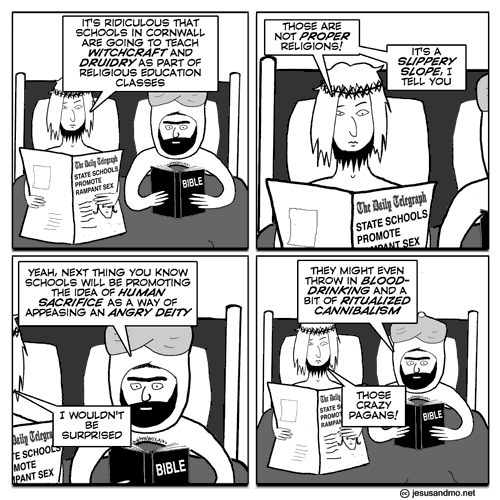
First: Some of the excellent ironic humour from the Jesus and Mo cartoons.


Next: News of the discovery of cave art that is older than any found so far.


Podcast of the week: I have become a big fan of WNYC's Radiolab podcast.  It is clearly very professionally produced but I forgive it for that.  It relies on a narrative style to tell a story in each episode.  As they say

On Radiolab, science meets culture and information sounds like music. Each episode of Radiolab® is an investigation -- a patchwork of people, sounds, stories and experiences centered around One Big Idea. Hosted by Jad Abumrad and Robert Krulwich, Radiolab

This week's was called Unravelling Bolero - and even in that title you can see a little clever humour if you know who wrote that music.

Another great podcast: Richard Dawkins' acceptance speech at the British Humanist Association's conference in Cardiff last month, courtesy of the excellent Pod Delusion.

Tweets of the week:

Apathy in the face of religion's schemes and power-grabbing is akin to surrender. @ProfessorIrony

Vatican announced in this era of equal opportunity God will now be ignoring prayers from Atheists as well as Christians.  @GodlessAtheist

Atheist blog post of the week:  The Lady Atheist, in Links of Shame: Religion in the News, provided a few links to news items suggesting that the law is finally catching up with religious criminals, and to other incredible religious news.


Life science of the week:  Ants flowing as a fluid


Controversial theism of the week:  A letter from a Jehovah's Witness mother to her son.  I can't decide whether it is moving or disgusting.

Favorite places: I have seen a few reports from Japan that the water in Osaka Bay has turned pale yellow, supporting fears of an imminent huge earthquake.  This site says:

A similar occurrence took place in 1995, shortly before the Great Hanshin earthquake of 1995, which was responsible for the deaths of more than 7000 people in Kobe and the surrounding vicinity. The area also suffered a large scale fish kill only last week, when several tons of dead sardines inexplicably washed up on the beaches . . .

Osaka Bay changing colour - from Fukushima Diary

Japan - one of my favourite places to visit - doesn't need another disaster.
Small note: My only skepticism about this is that there only seems to be one photo so far.

I hope you enjoyed this random walk through the week.  Your comments and preferences will help me to decide whether this is a good idea or not.


Does Rio +20 matter? YES!

What a stupid name for an important conference.  What does Rio +20 mean?

And it is beginning to look as though we are going to get a stupid, spineless and cowardly outcome from it too, unless real people - you and me - step in and help.   I know there's not much hope of influencing world leaders, but it must be worth a try.

A trillion dollars in tax subsidy to anti-green energy

Until recently, not many of us were aware that fossil fuels get FAR greater subsidies than other greener energy sources.  People criticise subsidies to green energy in absolute ignorance of the real situation.  Finally it is becoming clear that some of those people are shills for the oil companies.

Now it should have become clear to the rest of the population (if they were listening) that the oil companies and their cronies get a trillion dollars per year in tax subsidies.  That's quite a lot isn't it?  It is time to make a change.

A spineless agreement from Rio is worse than no agreement at all.

If you have enjoyed any of the content of Something surprising, please go to Avaaz.org, consider the arguments critically and have your say.

Abolish the subsidies!

Saturday, 23 June 2012

Things Christians Say, part 21: Real marriage

A weekly series of responses to the things Christians say to atheists, based on the video reproduced here on 30th January 2012.  The aim is to tackle one every weekend, to give both a moderate, polite response to each question ('Piano'), followed by a more forceful rebuttal of the same question ('Forte'). 

I really don't think your marriage can be considered a real marriage!


Piano

I'm quite curious to know why it is that Christians seem to claim the idea of marriage for themselves and try to define it in their own specific ways.  Even if that were acceptable, it has to be recognised that the different Christian traditions have their own ideas, often based on verses from the bible, but still not entirely consistent with each other.

In my own case this claim would not be true anyway, having been married in a Methodist Church.  In fact I always remind people that my late father-in-law married me, but that I didn't marry him.  (He was minister of that church you see!)

However, even if that was not the case, if I had married a Hindu, would my marriage be considered a 'real marriage'?  For many Christians the answer would be yes, since god in some form - maybe not your favourite form -  might have been involved.  What if I had married a Buddhist.  Most Buddhists are strictly atheistic, so are their weddings valid?  They are, at least, religious ceremonies.

Anyway - fortunately your opinion doesn't really matter.  Within the eyes of the real law (not religious law) marriages are quite well defined even if not yet entirely fairly.

***

Forte

Kindly define marriage for me. Is it the usual narrow-minded view of one man and one woman, married in a christian church by a special kind of witch doctor who happens to be ordained into one of the Christian cults that seem to proliferate so easily.  Or does it have to be your own particular cult - which you would probably prefer to be called a denomination?

Might your definition stretch to other religions perhaps?  I'm sure you have noticed that people all around the world get married to each other.  In some traditions polygamy is allowed.  What is your view of that?  And in yet others men are allowed to take child brides.  (Mohamed stretched this point to a point that most of us would consider to be inappropriate.)

I suspect that these forms of marriage are starting to reach a point that you are less comfortable with.  We haven't even started to talk about same-sex unions which you probably regard as being outside the definition of marriage.  But on what basis can you claim that.  As I have already mentioned, marriage comes in many forms that exclude your particular deity.

An entirely secular commitment between two people of either gender would hardly seem to me to be sinful, and your particular opinion doesn't affect me greatly unless it is imposed upon the society that I live in.  Personally I do not ever want to marry another man, but I don't think my own preference have any bearing on the rights of those who do.

Ooh . . . wait a minute.  Your view does seem to be imposed on my society to some extent.  Religions get too great a say in the proper process of government.  I do strongly object to that!

Before I finish, have you noticed that people like to get married in churches for the tradition of it all.  It is not that they believe in friends in the sky, but that it is seen as romantic and their friends and family expect it of them.

But don't delude yourself that they are getting married in church in order to involve God.  Most priests know that that is not the case but they continue to pretend - yes PRETEND -  that it is.


Last week: So - are you a communist too?
Next week:  The evidence is all around you. Just look at this world.

Friday, 22 June 2012

Pretending to know things that you don't know!

During an interesting interview on the new podcast, the Malcontents Gambit (43 minutes that I highly recommend) Peter Boghossian spoke in his usual clear and convincing way.

Discussions on the subject of faith require a clear definition of the terminology, and Boghossian has proposed a solution to this problem, which appears to clarify things rather well.  If you haven't come across Boghossian (and he does suddenly seem to be coming very much to the notice of the rational thinking community now) then you should Google for some of his work or see the links in the previous post.

Peter Boghossian - knowing things that
he can know

His definition of faith is "pretending to know things that you don't know".  Just substituting these words in a sentence often makes an obscure theological or doctrinal question turn into a clearly defined problem with a simple solution.

For example, when asked whether it is possible to have a meaningful and purposeful life without faith, he suggests that the question should be re-phrased by substituting his definition of the word faith.  The question then becomes "Is it possible to have a meaningful and purposeful life without pretending to know things that you don't know".  Surely the answer is then obvious.

Boghossian claims - I think rightly - that there are almost no situations where the word 'faith' needs to be invoked in the English language.  All too often the concept of faith is confused with hope, which is an entirely different thing.  People also tend to use faith as a system of epistemology - i.e. a system for the study of knowledge.  He suggests that the faithful have no right to claim that they have anything to offer on this topic.

When challenged that relying on the scientific method is the same as relying on faith, he quoted a martial arts friend, Matt Thornton, who insists that this is 'like suggesting that abstinence is a sexual position'.

Humanity's technological progress is solely attributable to recognition of the existence of external reality - not a faith.

The 'problem of induction' is often thrown out by proponents of faith.  They suggest that you have to have faith in order to believe that the sun will rise tomorrow.  Going back to the definition of faith helps with this though.  We do know why the sun appears to rise.  It is a simple matter of celestial mechanics and it would be very surprising if this changed overnight.  Faith does not come into the matter.

Truth matters because it enables us to make our lives better, improve life in our communities and promote better justice.  In fact, if you do not value objective truth, then the thing that you are valuing is arbitrary.  That is part of the problem of faith.  Indeed, even just having faith is a form of injustice to yourself.

Antagonistically, but quite sensibly, he criticises people who make claims about what will happen to them after death, and especially about what will happen to him.  He suggests that anyone who tells you that you will go to hell shouldn't be allowed to have any form of adult responsibility.  Maybe they should be allowed to write fiction, but not to do anything where rational decisions are needed.

There are four impediments to rational thought:
1/  Subjectivity and objectivity are too often confused.
2/  The definition of faith is not clear enough, and faith is too often confused with hope.
3/  Confirmation bias plays too large a role.
4/  Belief in belief - people tend to think that it is good to believe in something rather than nothing.

In feedback that he has received so far, he notes that people almost never say "Look, you're wrong and here's why" but almost always they will tell him that the bible says something different.  Almost all the e-mails he receives are an unsophisticated form of confirmation bias.


Amusingly, he also proposed that Gene Roddenberry's eponymous Mr Spock (in Star Trek, as you know) might actually have done damage to the cause of rational thinking.  By making Spock a character who has no emotions, there is a danger of people associating that quality with all rationalists.  Surely that is not something we would want, but setting that desire aside, Michael Schermer's book, The Believing Brain seems to shed light on the issue.  The hypothesis that we make our decisions and develop our beliefs emotionally, and then use our conscious powers to back them up rationally, is now very well supported.

He says that almost every moment of his waking day is spent discussing these things.  Interestingly he makes the surprising and refreshing claim that every single person in the world can be reached by rationality.  Personally he believes that the best way to reach difficult people is to be incredibly blunt and honest with them - as Richard Dawkins is.  He also suggests that you should never allow an argument to be shut down by someone claiming to offended.  As he says, "Your offence means nothing to me".

He finds that evangelical fundamentalists are easier to talk to than mushy moderates.  These are the sort of people that you can have a beer with!

Let's hope for more gems like this!


Related posts:
Introduction: Elect the fourth horseman - some candidates!
One from yesterday: Elect the fourth horseman - some candidates!
And from earlier this evening:  Boghossian leads by a mile

Boghossian leads by a mile

I'm not just surprised, but truly amazed at the level of interest in my slightly frivolous post yesterday about electing a putative replacement 4th Horseman as a mark of respect to Christopher Hitchens.  Thanks for all the comments.

Even more amazing was the consensus of opinion.  I feel myself slightly worried now.  To quote a famous author

Whenever you find you are on the side of the majority, it is time to pause and reflect. -- Mark Twain

Even while I was putting together the picture that I featured, I had in mind my own favourite candidate, a relative newcomer to the scene, whose work has been impressing me.  Nothing could have prepared me for the level of agreement in your comments.  I didn't even do much to lead the audience.

You can see from this bar chart what I mean.

Peter Boghossian leads the race - by quite a margin!

Many of my readers might not be familiar with Boghossian's work, but the results suggest that you should expect to see much more of him soon.

Shortly I will post an article about one of his recent interviews, Pretending to know things that you don't know!   Meanwhile here are the links to a couple of his videos. If you are aware of any others, please post links in the comments.

Jesus, the Easter Bunny, and Other Delusions earlier this year.  (35 minutes.)

Faith: Pretending to know things you don't know, May 6th 2012 (37 minutes)


Thursday, 21 June 2012

Elect the fourth horseman - some candidates!

In yesterday's post I introduced the idea that it might be time to 'elect' a new fourth horseman, who who have the tough task of replacing Hitch. It would be difficult.  To quote one of the remaining three:

Hitch had more wit and style than a few civilisations that I could name! -- Sam Harris.

The role might be one like that of Paul in the New Testament - not there at the beginning but amazingly influential in the progress of his cause. 

Who might we have on the candidates list?

Elect the 4th Horseman's substitute

These are the names that I could suggest, listed in strict alphabetical surname order (although not in the same order in this picture).  All of these people have strengths as great as Hitch's, albeit in different areas.

Ayaan Hirsi Ali, Dan Barker, Peter Boghossian, Jerry Coyne, Brian Dalton (Mr Deity), Matt Dillahunty, Sean Faircloth, Penn Jillette, A C Grayling, Paula Kirby, Lawrence Krauss, Pee Zee Myers, Maryam Namazie, Steve Novella, Aron Ra, James Randi, Michael Schermer, Eugenie Scott, Victor Stenger, Neil deGrasse Tyson.

I'm sure there are many others.  Add your suggestions in the comments, which are allowed to be anonymous if you prefer.


Small note: Nobody called Rebecca is on the list!


Related Posts:
Introduction: Elect the fourth horseman - some candidates!
Initial results of the responses:  Boghossian leads by a mile!
Some of Boghossian's work summarised: Pretending to know things that you don't know!
And one from yesterday: Could anyone ever replace Hitch?

Wednesday, 20 June 2012

Could anyone ever replace Hitch?

With the sad demise of Christopher Hitchens last December, I have been wondering whether anyone else might be 'elected' to the honorary position of '4th Horseman of the Apocalypse', joining Richard Dawkins, Daniel Dennett, Sam Harris.  In fact, I have been wondering whether anyone ever could replace him and who might be qualified to decide anyway.  Is it a democratic vote?  Is it another opportunity for the diverse rational community to be split again? (Or are we lucky enough to find that Rebecca Watson is too busy in her other campaigns of self-publicity to bother herself about this one)?

Three remaining 'horseman',
with worthy guest, Ayaan Hirsi Ali from here.
On Sunday I gave you this link to an excellent Youtube video of Ayaan Hirsi Ali on stage with the remaining three 'horsemen' at the 2012 Global Atheist Convention, 13-15th April, in the Melbourne Convention Exhibition Centre.

Although I know I'm not in a position to have any credible effect on this topic, I am going to indulge myself in a little speculation about the possible candidates.  I can only work from my own limited experience, but I will give a 'shout out' to some of the people who have most influenced my thinking over the last couple of years.

That the original horsemen are firmly on my list goes without saying.  If that were not the case I would not be writing this.

What criteria are important in this selection though?
  • Do the existing three have to approve the selection, or indeed make the selection themselves?  (I'm sure they would want to influence the choice).
  • Is it necessary for the 4th horseman to be a man?  (A tricky, potentially divisive question!  I vote for equality, and against positive discrimination.)
  • Do they have to be white?  (Let's hope that is neither a requirement, nor a reason for positive discrimination.)
  • Must they be an English-speaker?  (I think the answer is yes, in this case, but accept that English need not be their first language.)
  • Should the selection be based on their profession or their performance?  (It would be hard to find another well-read polemicist and commentator like Hitch, but all to easy to select another philosopher to join two of the remaining three.  The trouble is that that might tip the balance too far from the real world.)
  • Indeed should we ban scientists and philosophers from consideration, in favour of an unbiased and well-practised communicator? (I hope not.)
  • Do they necessarily have to be an atheist?  (I think the answer is yes, but . . . what do you think?  e.g. the deist, Thomas Paine, could easily have been a candidate if he was still alive.)
  • Or does nobody care?  (Its quite possible!) 
In the next post, Elect the fourth horseman - some candidates, I will venture to suggest the names of some candidates and invite you to suggest others who I ought to find out about.  If nothing else, we might all learn about the work of some of the stars of freethought who we didn't already know.


Related Posts: 
Next post: Elect the fourth horseman - some candidates!  (Huge number of comments with a clear consensus.)
Initial results of the responses:  Boghossian leads by a mile!
Some of Boghossian's work summarised: Pretending to know things that you don't know!