Showing posts with label Mystery. Show all posts

Saturday, 25 May 2013

Perspectives on the Cambrian Explosion

I must have been listening to too much pro-ID propaganda!  (I have!)  The proponents of Intelligent Design put up a superb, almost-convincing, smoke-screen and one of their favourite topics is 'The Cambrian Explosion' and that Darwin himself had recognised this as a problem.  They claim that the increased rate of evolution in that period of a few tens of millions of years, about half a billion years ago, shows evidence of the presence of an intelligent designer.  This seems to be based on a claim that information cannot be created except by intelligence.  More on that topic soon! 

Of course sometimes they take that trouble to pretend that this is not a religious claim!  Honestly it isn't.  You can believe everything they say, including this claim.

Reading the Wikipdia article about The Cambrian Explosion this evening, I was reminded that conventional science is by no means short of ways to explain the phenomenon, including:
  • 'Large' animals of diverse types did exist before, and the evidence for them is growing steadily (in spite of the claims of ID's proponents)
  • There are some special layers called lagerstätten, which preserved soft body parts unusually well, and several of these were in the Cambrian period
  • Evolution was faster than 'normal' but not by more than a factor of ten or so, and there were other periods when 'explosions' happened, including the Devonian and Cretaceous
  • A sudden increase in the amount of calcium in the oceans might have been significant for the innovative production of bony body parts
  • The end of a previous ice age might also have mattered a lot.

All in all, the presence of an intelligent designer is not the only plausible explanation, and not even the most probable, for various reasons:
  • How long did this particular intelligent designer live, as the Cambrian explosion lasted for tens of millions of years? 
  • If it lived for that long, does that imply that it was God after all, or was it a family of shorter lived designers?
  • If it was God, why was he so busy for that short period before leaving things to themselves for 500 million years?  Only after that time did he complete his perfect world, where he created original sin and all the other bad things.
  • If it was God, how did he evolve anyway?  If you can't explain this then the problem has only been deferred, not solved.

Case for God not proven! I also note that I and D are the first two letters of an uncomplimentary five letter word.

Small note:  Obviously when Meyer's new book 'Darwin's Doubt' is released (at an exorbitant price from here, but only delivered within USA) we will learn the answers to all our doubts.  In the meantime we still have the opportunity to listen to the whining voice of Casey Luskin on the Discovery Institute's podcast ID The Future telling us that he has read it and that it explains everything beautifully.

Monday, 13 May 2013

My two 'spirit guides'

A dear friend told me today that I have invisible companionship.

This is not just one spirit guide, but two!  Apparently not everyone is blessed in this way, but it is far from unusual.  My friend claims to have more guides than me.

I find it genuinely interesting that I know people who believe in things that I can't recognise in the world.  My Christian friends know God through his son Jesus (in spite of all that nonsense about the Trinity which makes no real sense to anyone as far as I can tell).  My Islamic friends have faith in Allah and his prophet Mohamed (upon whom I wish no peace or blessing whatsoever).  At least Islam is a little less 'spooky', even though I find it more frightening in other ways.  And my own sister sees ghosts and has always been much more sensitive to the paranormal than I am.

I'm almost jealous of them.  It seems that I am missing this special, interesting, sixth sense.

I don't even believe that we have souls in this dualistic sense, so I find it very difficult to believe in ghosts or spirits.  But I am still fascinated by the idea.

As for these invisible companions who (apparently) know so much about me, very little has been revealed.  They don't have names and nothing is known of the lives that they no longer have.  Both are (or were?) male, which I find genuinely surprising since the minority of my close friends would want to claim that. 

Apparently one is mischievous and the other is 'a free spirit'.  What that happens to say about me is unclear.

What questions can I ask my friend to find out more about my guides?  Your input would be useful.  Please leave a comment if you can help.  I can already think of a few questions.
  • Have they chosen me of have I chosen them?
  • Do they like me?
  • Do they 'guide' anyone else?

Any more?


Friday, 3 May 2013

Adam Rutherford at Oxford Skeptics

The speaker at Oxford Skeptics in the Pub this week was one of the best yet.  Adam Rutherford engaged an audience of about 60, speaking on the subject of 'Creation'.   The event was held in a new location, the St Aldate's Tavern.  A good choice, I must say!

When I say that he engaged the audience, he used wit and wisdom to answer questions and challenges in the most interesting round-about ways, and yet still managed to give a satisfactory answer.

There is no point trying to give an account of the talk that he gave.  I will just note a few of the things that I found surprising.
  • The family tree of Charles II of Spain, the last of the Hapsburgs, with all its inter-generational loops.
  • The Murchison meteorite, which contains traces of one of the four letters of the genetic code - one that we find it difficult to synthesise here on Earth.  (And yet the hypothesis of panspermia was rejected as non-scientific.  Apparently it is a nice idea but there is no evidence for it.)
  • That the Miller-Urey experiment was actually more successful than originally thought.  In fact, it produced all 20 essential amino acids - many more than there were able to identify at the time.
  • A definition of life - "Life is the opposite of decay"
  • GM cress which detects land mines by changing colour - and yet is not on the market due to an intellectual property dispute.
These and a few others were the highlights of the evening.  Congratulations to Heather for finding such a good speaker.

A great evening out!  If you get chance to see him you should take it.

Small note: Boo to Martin Robbins for trying to be more than an 'ordinary member' of the audience.  He wasn't a very interesting speaker when he was supposed to be the speaker, and he wasn't much better as a member of the audience.

Monday, 18 February 2013

Swedish icy mystery

My friend and colleague, Tom, was visiting family in Sweden recently and on a forest walk he came across this remarkable and so far unexplained icy feature and photographed it.

Surprising sharp edge around a patch of ice.  Swedish icy mystery.
Surprising sharp edge around a patch of ice. 

At first glance it just looks like an icy puddle, but when you look more carefully it has some very peculiar and surprising features.

Closer view of the upstanding edge - Swedish icy mystery!

Tom described it as follows:

I have never seen or heard of anything even remotely like it before. I probably saw about a thousand other frozen puddles that week, and none of them had any unusual features at all.

Swedish icy mystery. Stalks of grass through the mysterious sharp ice feature.
Stalks of grass through the mysterious sharp ice feature.

It had snowed about 10-15cm some days before we got there and this had largely thawed by the time of this forest walk, after several days of the temperature being about -2°C overnight and 0 to +2°C during the day.

There are many deer in the forest, and a few dog walkers. Several other puddles showed evidence of the water level having gone down under the ice crust before refreezing. I now see that where some larger grass stalks had lain through the developing ice wall, presumably wiggling in the breeze, they have made round holes in the wall. The little ones are just frozen in position as I described the other day.

Swedish icy mystery. Another view - including a reed passing through a melted hole.
Another view - including a reed passing through a melted hole.
Perhaps the explanation for the large green reed having melted a hole is more related to it being a dark colour, and thus collecting more warmth from the sun, but how this sharp edge was formed is still a mystery.

So . . . are there any arctic explorers out there who have an explanation please?

Wednesday, 5 December 2012

'The Bloop' explained!

Of all the mysterious sounds of the sea, a noise recorded in 1997 by hydrophones under the Pacific has been a mystery ever since.

'The Bloop' was a low frequency sound that was 'romantically' attributed by some people to a large, unidentified and unknown sea creature.  (A creature that only talked once in the last 15 years!)

You can read more about it and other deep sea mystery sounds at this link, hear Brian Dunning's account of it on the Skeptoid podcast here, or hear a somewhat repetitive Youtube video of the event here.

But now we finally have an explanation for this sound which was loud enough to be heard 5000km from its source.  (Note that sound travels anomalously well under water, but that is still pretty surprising.)  It seems, according to an account of the event by NOAA  that it is consistent with the sound of an 'icequake' - cracking of a glacial shelf.  The sounds are propagated through the ocean in such a way that a bloop would be heard.  They say:

The broad spectrum sounds recorded in the summer of 1997 are consistent with icequakes generated by large icebergs as they crack and fracture. NOAA hydrophones deployed in the Scotia Sea detected numerous icequakes with spectrograms very similar to “Bloop”. The icequakes were used to acoustically track iceberg A53a as it disintegrated near South Georgia Island in early 2008. Icequakes are of sufficient amplitude to be detected on multiple sensors at a range of over 5000 km. Based on the arrival azimuth, the iceberg(s) generating “Bloop” most likely were between Bransfield Straits and the Ross Sea, or possibly at Cape Adare, a well know source of cryogenic signals.

In some ways it is a shame to spoil a good mystery, but if I took that attitude with everything then I would never have any feeling of satisfaction at work.

Old mysteries are still fun, even if you have an explanation!

Small note: I'm not sure that icebergs count as cryogenics!

Wednesday, 31 October 2012

'Made-up' festivals?

Earlier this year, an Australian bishop called Forsyth said:

"Halloween is a made up festival about death, Easter is a real world festival about life."

Hmm.  Really?  What is wrong with this statement?

Well when you think about it almost all of it is questionable.

One might argue that Halloween was made up, but when you think about it, that invention happened a very long time ago.  Halloween is based on the pagan festivals of Samhain and Beltaine if I remember correctly.  It far pre-dates Christianity.  If we are being pedantic, it isn't really about death.  It might be about the dead, but that is different.  One would expect a bishop to be less semantically challenged than that.

On the other hand, the only basis for evidence of the truth of Easter is the mutually contradictory evidence of the books of the bible (and arguably the way that present day Christians just know things to be true by revelation).

In other words, Easter is just a 'made up festival about death' too.  So what is the difference?

Should I go on about how Christianity's festivals are all coincident with earlier pagan festivals?  I could point out that their origins are all questionable.

Maybe I could ask whether the day after Halloween, All Saints Day, is also a made up festival about the dead (and perhaps even their deaths).

To cap it all, certain Polish bishops have been claiming that celebrating Halloween is actually dangerous.  Archbishop Andrzej Dziega warned that Halloween was behind a "culture of death".

"This kind of fun, tempting children like candy, also poses the real possibility of great spiritual damage, even destroying spiritual life," and that "irresponsible and anti-Christian fun" introduced young people to a "world of darkness, including devils, vampires and demons" in the name of "fun".

So . . . its time to make up your minds.  Is it a made-up festival or is it a real-life world of darkness?

It can't be both.

Friday, 12 October 2012

A test for your atheism.

I've been wondering for a while whether there is a really good test of one's degree of atheism, and recently a few things had brought me to a tentative conclusion.

I would like to suggest that our attitude to death might be the final give-away.  I don't just mean death in general, but specifically our own mortality.

Of course there is a broad spectrum of hopes and beliefs, and in a short blog post I can only speak in very general terms.  I think is possible to narrow down our attitudes to four main points of view and I'll try to place these on Richard Dawkins' spectrum of beliefs. (From page 50 of The God Delusion; 1 is a strong theist, and 7 is a strong atheist.)

1/  You know that there is a heaven and you are confident that you will get there because even if you are not perfect, you are repentant and you know in your heart that this is true.

3/  You don't think about it often, but when you do you are pretty sure that there is an afterlife and you fear that you might go to hell and suffer eternal torment.  You don't fear this quite enough to change all your life decisions, but it does nag at you.  But still . . . there is always time to mend your ways and to repent later.  (Or is there?)

5/  You don't think about it often, but when you do, you still have a lingering sense that you have a spirit or soul, and you would like it to live on after your mortal life is over.  You want this in some unspecific spiritual sense, since you don't really believe in the gods that others worship.  However, you are still horrified at the concept of your own mortality.

7/  You know that there is no 'hope' of an afterlife and find this viewpoint to be quite soothing - even therapeutic.  After the highs and lows of a life lived well (or badly) you will neither be subjected to the continuous joy of paradise (which must get boring eventually) nor to the eternal torments of hell.  After death there will be perfect peace and your entire being will cease to be.  And you really don't mind!  You think "when I'm gone, don't grieve for me, but look after the people who loved me".

Now I know that the words are slightly skewed towards what I might call 'Christian atheism'.  By that I mean the kind of atheist who has rejected the idea of the Christian God and ignores even the existence of the other options.   However, I think it might work for Muslims if the words were changed a little, and for other religions to varying degrees.  In the case of Buddhists this scale tests something other than atheism, since they are all atheists, but I think a Buddhist apostate could aspire to reach 7, with practice.

Religions clearly foster the human desire for an afterlife.  It is one thing that almost all of them have in common.  Indeed the afterlife might be the carrier of the virus of religion.

If I score 7, does that mean that I'm not enjoying my life enough?  What do you think?

Monday, 4 June 2012

Mixing sciences badly

Publicised today on Richard Dawkins.net, was an account of a Nobel laureate, Luc Montagnier, who has turned his interest to pseudo-science, specifically low frequency resonances in DNA and the memory of water, and thus is gaining interest from the homoeopathy community.  There are quite a few skeptical comments there already, but having a background in the physical sciences I though I would post a comment with that slant.  I have also blogged previously about Schumann Resonances, which the authors claim to be relevant to the subject.

The original article by Steven Salzberg was published by Forbes (here) and the self-published paper by Luc Montagnier can be found at arXiv by following this link.  My comment (number 18) was as follows.  It is rare for anyone to read and respond to my comments on RD.net so I don't do it often and I reproduce it here in the hope that someone will bother to read it!  

Don't get me wrong - I think that the best chance of making discoveries in science is through inter-disciplinary co-operation.  But the question is,"is this a good example of that co-operation?"

There are several interesting aspects in the physics of the measurement. Most importantly, it is actually rather difficult to transmit and measure these low frequencies, and indeed on this scale it is doubtful whether the measurements are even physically meaningful. Part of the problem is that 7Hz electromagnetic waves have a wavelength of around 42,000 km. Normally, in order to transmit any frequency you might aim for an antenna of quarter of a wavelength, or in this case 10,000km in length. Even strands of DNA are not this long, and anyway they are somewhat folded and therefore self cancelling.

Detection of low frequencies can be managed with small coils as long as they have enough turns, (e.g. 5000 to 10,000) so in principle their equipment might be able to make the measurement, if the DNA had a mechanism to transmit it - which it doesn't.

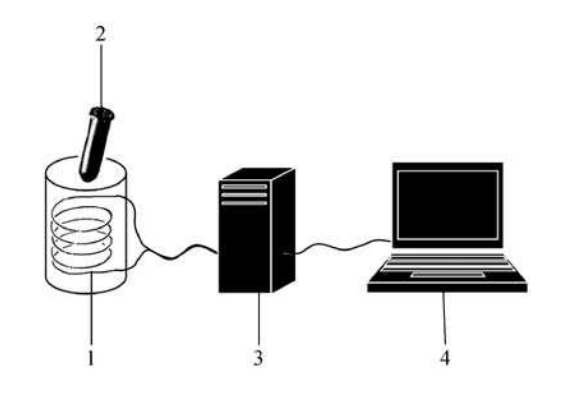
On top of that, there is very little detail about the equipment used, except a kindergarten-level sketch of a coil, an amplifier and a computer to measure something inside a test tube.

Risible physics!

They do happen to mention the impedance of the coil, which is a start. However, unless that impedance is well matched to the amplifier it means nothing. The connecting cable is incredibly important too. How well is it shielded and what is its impedance and does it match? Then the bandwidth of the amplifier matters. Does it work at all in the frequency range in question, and what is its gain? After that we have to ask how the analogue to digital conversion is carried out. What type of D/A converter is used? What frequency range does it cover? How many bits deep are the data?

But of course the controls that they adopt make all this inconvenient physics irrelevant don't they. It must be true after all! This measurement is not at all like the famous measurement of the faster-than-light neutrinos is it? The two are comparable in the surprising nature of their results, but it has taken many months of professional research for the neutrino problem to have something close to an explanation.

The sentence that I liked best in the paper was "At this point the most critical step was undertaken, namely to investigate the specificity of the induced water nanostructures by recreating from them the DNA sequence".
I can't help but crack a smile!

They make a big thing of Schumann Resonances. They, at least, are a real phenomenon. The lowest frequency Schumann resonance is 7.83Hz, and its wavelength corresponds to the circumference of the earth.  (See first paragraph.) For interest, this link shows the sort of equipment that might be used to measure Schumann frequencies. This paper also demonstrates the measurement difficulties. On page 1 there is a graph of the Schumann frequency peaks.

Schumann resonances - the problems of interference (from here)


They are dwarfed by an interference signal from the Deutsche Bahn (railway). The nearest railway is 30km from the place where the measurement was made!

Case not proven!  Extraordinary claims require extraordinary evidence don't they.

Friday, 27 April 2012

Apparently, Jesus never existed

Sometimes in the past I have posted about the historicity of Jesus, and the lack of evidence.  I have mentioned the similarity between the Jesus myth and other, much earlier, stories.

Keeping a skeptical eye on the evidence, I like to remain aware of the possibility that I might be falling for mis-information that is being spread mischievously.  Certainly some of the claims of similarities between the Jesus story and others are a little bit exaggerated, and correspondents have pointed this out to me now and then.  (e.g. Justin's comments on this post about Jesus and Horus which seem to be very fair.)

So imagine my interest in finding a site called www.jesusneverexisted.com, where virtually every story that you ever heard in all your skeptical life seems to have been collected.

jesusneverexisted.com - where are the fallacies?

If you have any interest in the ideas suggesting that the whole of christianity is built on very poor foundations, I think you will enjoy exploring that site. 

To give you a taster, the following is probably only about 10% of the content of the home page alone. 


Do you really think it all began with a sanctimonious Jewish wonder-worker, strolling about 1st century Palestine? Prepare to be enlightened.

  Jesus – The Imaginary Friend
Christianity was the ultimate product of religious syncretism in the ancient world. Its emergence owed nothing to a holy carpenter. There were many Jesuses but the fable was a cultural construct.
The nativity yarn is a concatenation of nonsense. The genealogies of Jesus, both Matthew's version and Luke's, are pious fiction. Nazareth did not exist in the 1st century AD – the area was a burial ground of rock-cut tombs.
With multiple authors behind the original gospel story it is no surprise that the figure of "Jesus" is a mess of contradictions. Yet the story is so thinly drawn that being a "good Christian" might mean almost anything.
The 12 disciples are as fictitious as their master, invented to legitimise the claims of the early churches. The original Mary was not a virgin, that idea was borrowed from pagan goddesses. The pagan world knew all about virgins getting pregnant by randy gods: The Mythical "Virgin Mother".
Scholars have known all this for more than 200 years but priestcraft is a highly profitable business and finances an industry of deceit to keep the show on the road.
"Jesus better documented than any other ancient figure"? Don't believe a word of it. Unlike the mythical Jesus, a real historical figure like Julius Caesar has a mass of mutually supporting evidence.
The case for a mythical Jesus – Nailing Jesus.


Not only does it address the stories of Jesus, but it goes on to explore the myths about Paul too.

Enjoy!

Friday, 16 March 2012

Not so fast with the neutrino mystery!

When I attended the village Harvest Festival supper last year, the news about neutrinos travelling faster than light had just hit the headlines.  Since it is known that I work in 'big physics', several friends confronted me with a smile, and various versions of the same question, dressed up as a statement.  "So! Physics is wrong then!"

At the time I was amused by this interrogation, and it reminded me that it was an opportunity to spread the word about how science progresses.  For very many people it is surprising to find out that being wrong is an opportunity to find something new.  It is sometimes said that physicists like nothing better than hearing what they already know.  This 'confirmation bias' is a feeling that we all have, for most of our lives.  We like to believe that we understand things, even if we are deluding ourselves. 

However, for most of us who work in science, the 'second best' thing in our professional lives is to find a surprising mystery that challenges our 'beliefs' and opens up the chance of learning something that nobody has ever known before.  The mystery of the neutrinos that might be travelling faster than light definitely falls into this category.  So much of fundamental physics points to the complete unlikelihood of the observation, but nevertheless the observation had been made. 

In actual fact I think almost every physicist was skeptical about the claim - and this would include those who had made the observation and who were calling on the broader community to explain where they might have gone wrong.  After all, we know exactly how fast ordinary neutrinos travel compared with light and would be surprised to think that those created by CERN would behave differently.  The very best and most sensitive evidence came from observations of a supernova known as SN1987A.  The light from this distant exploding star took 168,000 years to reach us and the burst of neutrinos arrived just 3 hours earlier.  We know for certain that the neutrinos came from the same direction and we understand how light can be delayed in its journey.  Light reflects and scatters from particles of matter on its way here - the neutrinos just go straight through.

SN1987A supernova - a great neutrino source!
Image from here


Even last October, the 'smart money' was on the likelihood of a subtle experimental error, and now, months later there are rumours that there are two possible candidates.  As it happens, these two tiny imperfections in a huge and complex experiment would have opposite effects.  One would make the neutrinos appear to be going even faster, and the other would make them seem slower.  Nobody yet knows which one of these dominates the measurement, but in May there is a good chance that they will find out.  At the moment, we just know that the error in the measurement is big enough to include the expected result that neutrinos do not break the light barrier.

So what does this reveal about the path of science?  I think that the openness of the scientific community, and the ease with which news can now be transmitted to the public, are strengths that we should celebrate.  The media exploits this openness for its own ends - namely profit.  However, at last the general public are able to see that science progresses in little steps, with our models of the universe getting closer to the truth each time.  Some of the steps take us backwards but they probably teach us something anyway.

The best comparison I can make to everyday life is that of seeing a delicious sausage being made.  It is perfectly OK if you are squeamish and decide not to watch what goes into the sausage, but if you don't watch then you are missing something about life, part of the path to true understanding of our universe.    In my own case I'm probably more squeamish about making a sausage than making science, but everyone is different!

Small note:  This has been written to go into a local magazine, but it was published here first!

Tuesday, 28 February 2012

Thomas Paine - the first 'New Atheist'?

Thomas Paine, author of The Age of Reason, had an 'interesting' involvement in the French Revolution.  At the time he was living in France and although he was an English born 'Founding Father' of USA, he was acting as an elected member of the French National Convention when the revolution happened.  Things did not go well for him, but at least he escaped with his life.

Thomas Paine - an atheist and a deist.

Paine was a deist - in other words he believed in a creator of the universe but not a creator who intervened in its workings.  He was quite fervently anti-christian, and having been reading The Age of Reason I will be sure to write about him again in the future.

For the time being, here is what he said about the subject of miracles, with an interestingly humorous comment about Jonah and the whale.

Of all the modes of evidence that ever were invented to obtain belief to any system or opinion to which the name of religion has been given, that of miracle, however successful the imposition may have been, is the most inconsistent. For, in the first place, whenever recourse is had to show, for the purpose of procuring that belief, (for a miracle, under any idea of the word, is a show), it implies a lameness or weakness in the doctrine that is preached. And, in the second place, it is degrading the Almighty into the character of a showman, playing tricks to amuse and make the people stare and wonder. It is also the most equivocal sort of evidence that can be set up; for the belief is not to depend upon the thing called a miracle, but upon the credit of the reporter who says that he saw it; and, therefore, the thing, were it true, would have no better chance of being believed than if it were a lie.

Suppose I were to say, that when I sat down to write this book, a hand presented itself in the air, took up the pen, and wrote every word that is herein written; would anybody believe me? Certainly they would not. Would they believe me a whit the more if the thing had been a fact? Certainly they would not. Since, then, a real miracle, were it to happen, would be subject to the same fate as the falsehood, the inconsistency becomes the greater of supposing the Almighty would make use of means that would not answer the purpose for which they were intended, even if they were real.

If we are to suppose a miracle to be something so entirely out of the course of what is called nature, that she must go out of that course to accomplish it, and we see an account given of such miracle by the person who said he saw it, it raises a question in the mind very easily decided, which is, is it more probable that nature should go out of her course, or that a man should tell a lie? We have never seen, in our time, nature go out of her course; but we have good reason to believe that millions of lies have been told in the same time; it is therefore, at least millions to one, that the reporter of a miracle tells a lie.

The story of the whale swallowing Jonah, though a whale is large enough to do it, borders greatly on the marvelous; but it would have approached nearer to the idea of a miracle, if Jonah had swallowed the whale. In this, which may serve for all cases of miracles, the matter would decide itself, as before stated, namely, is it more that a man should have swallowed a whale or told a lie?

But suppose that Jonah had really swallowed the whale, and gone with it in his belly to Nineveh, and, to convince the people that it was true, had cast it up in their sight, of the full length and size of a whale, would they not have believed him to be the devil, instead of a prophet? Or, if the whale had carried Jonah to Ninevah, and cast him up in the same public manner, would they not have believed the whale to have been the devil, and Jonah one of his imps?

The most extraordinary of all the things called miracles, related in the New Testament, is that of the devil flying away with Jesus Christ, and carrying him to the top of a high mountain, and to the top of the highest pinnacle of the temple, and showing him and promising to him all the kingdoms of the World. How happened it that he did not discover America, or is it only with kingdoms that his sooty highness has any interest?


Interestingly, I believe that if Paine lived today he would have realised that his deistic god had been backed so far into a corner that deism was not longer a defensible argument.  His rational and reasoning mind would be a great addition to the ranks of the present New Atheists, and he was perhaps the historical character who was nearest in every way to the late, great, Christopher Hitchens.

One could almost call Paine 'the first of the New Atheists', even though he died in 1809!

Monday, 27 February 2012

Greatest adversary of Yahweh

Following on from yesterday's post about finding the Ugaritic Texts in Musée du Louvre last weekend, here are some more detailed pictures of the tablets.  You can find more about these tablets in a post last July about The Ugaritic Texts.

The first picture is of a tablet which says in the French commentary to the right that Baal was presented as the greatest adversary of Yahweh.  I will not attempt to translate any of the others, but have added a relevant caption to each.

Their location in Musée du Louvre can be seen in yesterday's post.

Ugaritic Texts - the greatest adversary of Yahweh

Ugaritic Texts - Functionaries of a temple

Ugaritic Texts -Legend of Danel

Ugaritic Texts - Hierarchy of the gods of the kingdom of Ugarit

Ugaritic Texts - Mythological poem of the life and death of Baal

Ugaritic Texts - Mythological poem of the life and death of Baal (fragment)

Ugaritic Texts -Birth of the gods

Sunday, 26 February 2012

Finding the Ugaritic texts in the Louvre

Last July I wrote a series of articles about the gods of the Old Testament including a post about The Ugaritic Texts.  Yes - I said 'gods' rather than God.  It seems very clear that there was 'pantheon' of gods at the time and God (a.k.a Yahweh) was just one of them as you can read at that link.

Finding myself in Paris on a Saturday afternoon with no other commitments for a few hours, I took the opportunity yesterday to go to Musée du Louvre to look for the actual Ugaritic Text tablets and to see them for myself.  Just having seen pictures of the tablets without seeing their context, I didn't have a good feel for the size of them or indeed the number of finds.

Musée du Louvre, in February 2012
Finding them was a little tricky.  Even asking one of the guides (and finding for the only time in 3 days that my French is not good enough) did not help.  Sitting in the Mesopotamia rooms of the Louvre, at first I thought he was just one of those arrogant Parisiens that you hear about but don't often meet.  After a while I realised that he was only arrogant because he was also ignorant of the archaeological treasures surrounding him.

C'est la vie!  I found them a bit later all by myself, in room B of the ground floor area of the 'Sully' section of the Louvre.  I gained access to that area through the 'Richelieu' wing.  No doubt there might be easier ways to get there but I happened across some other interesting and famous artifacts on the way there. More about the amazing Code of Hamurabi in a few days time.

For today, here are a couple of photos of room B.  Tomorrow I will post photos of some of the tablets themselves.  First an overview of the room looking towards the North-East.

Musée du Louvre, Sully, ground floor room B

This is the cabinet containing the Ugaritic texts

Where in Musée du Louvre are the Ugaritic texts?  In this cabinet.
and this is a bit more detail of the cabinet itself

The cabinet containing the Ugaritic Texts in Musée du Louvre

More detail coming tomorrow, but just to finish this post on an incongruously surprising, lighter note, I thought you might smile at a sticker that I saw on a motor bike in Paris.  At the least, it is an interesting example of 'Franglais'.

J'adore rien - I'm parisien!

Thursday, 13 October 2011

Xenoglossia

In yesterday's post about 'speaking-in-tongues', I mentioned another more interesting and more testable speech phenomenon.  This is where people seem to be able to speak a real foreign language that they could not possibly have come into contact with.  Sometimes you hear anecdotes about people who have had a stroke and although they have lost their native language they seem to have switched to another language entirely.

Does it really happen?  If it does it would be truly remarkable.  You would expect the evidence to be cut-and-dried.

Sadly, the internet is not exactly awash with provable or convincing cases and the lack of good evidence does seem to suggest that xenoglossia is another case of 'the story teller's art'.  The same few stories are repeated frequently on multiple sites.

There are tales of American lady being hypnotised and then speaking as a young German girl, of a Japanese housewife who speaks perfect Nepali, various people in India who could suddenly speak another language  and a girl who speaks an ancient Egyptian dialect (which is obviously not easily falsifiable).  A high proportion of the accounts that I have found seem to have at least a tenuous link to the psychic community and therefore are not to be trusted at all.

Even some of the more credulous sites resort to this sort of statement:

Many findings of xenoglossy are still suspect since most documented incidents have proven to be false. The "unknown learned foreign" language proved to be nothing more than forgotten phrases discovered in the subconscious, or pseudo- languages which were pure gibberish. In fewer cases the phenomenon appeared to be telepathy results between two people such as a hypnotist and a subject.

Ah - so it was telepathy all along then?  That makes it much more credible!

Some of the cases often reported are examples of 'proof by Daily Mail' (a UK newspaper with a bit of a reputation for sensational stories that appear to be true, but might not be).  In the particular case linked here, The Mail neglects to mention that the man lost his ability before it could be tested by anyone who could independently confirm the claims.

Sadly, my skepticism is undented by what I have read.  That's a pity.

Wednesday, 12 October 2011

Only a facade of language

Glossolalia, or 'speaking in tongues', is sometimes claimed by Pentecostal christians to be a sign that they have been touched by the 'holy spirit'.  It has many biblical precedents, which of course makes it undeniably true.

Or does it?

The phenomenon has been extensively studied in many different communities around the world, and perhaps the first surprise is that is is by no means exclusive to the pentecostals or even to christians.  To me, it is analogous to Pascal's Wager.  (See an earlier post called Pascal's Gambling Debts).  In a universe where everyone agreed that there was only one deity (not like our universe) communication with god might be a possible explanation, even if it is not testable.  But since shamans, spiritualists and pagans also exhibit the same phenomena I think it is hard to argue that god is behind it all.  Which god?  Or should I ask 'who's god'?

Indeed, a study in the 1970s by linguist William Samarin showed that the structure of the utterings was not consistent with it being a real language and he described it as being 'only a facade of language.

Neuroscientists conducting brain scans on people who were speaking in tongues have confirmed that the areas of the brain responsible for language go surprisingly 'quiet', while the areas that produce emotion become very active.  There is little doubt that these people are emotional and I believe that most of them are doing it in good faith and not just putting on an act.

However,  you can begin to see the signs that I am skeptical of the straight-forward claims that god is influencing the people to speak like this. 

But I am not alone in these doubts. Not even all 'the faithful' have any time for 21st century speaking in tongues

The Wikipedia article explains that some christians, the 'cessationists',
believe that all the miraculous gifts of the Holy Spirit ceased to occur early in Christian history, and therefore that the speaking in tongues practised today is simply the utterance of meaningless syllables. It is neither xenoglossia nor miraculous, but rather learned behavior, possibly self-induced. These believe that what the New Testament described as "speaking in tongues" was xenoglossia, a miraculous spiritual gift through which the speaker could communicate in natural languages not previously studied.

Now we come to a much more interesting topic.  Xenoglossia is a phenomenon where people claim to be able to speak or write a (real) foreign language that they could not possibly have learned.  I'll come back to that another day.  It sounds much more interesting!

Sunday, 28 August 2011

Kangaroos - the final evidence against Noah?

Concluding the mini-series on the myth of the flood . . .  

Taking the bible literally - as we all do of course - the kangaroos must have been rescued by Noah.

That's a bit unfortunate for Noah really, because as evidence goes, they seem to be a final nail in his coffin.  They are such a dead-giveaway that the whole story can't be true. Creationists jump through so many hoops to find explanations that it is quite amusing (and yet strangely unsettling at the same time).

Aside from the difficulty that Noah would have had collecting them (as I think there is little to suggest that they were originally indigenous to the Middle East), when he released them they seem to have found their way back to Australia and nowhere else on earth. 

You might argue that the original two roos managed to get there and had their offspring when they arrived, but I don't think this idea hangs together.  How long does it take a pair of animals to get half way round the world on foot?  Presumably reproduction was also quite a high priority for them, as they only had one lifetime to start off a new species and didn't have time to waste.  They must have started making babies as soon as they could.  Then we seem to have to assume that no baby kangaroos got lost along the way to Australia, which seems a little unlikely.

There are, of course, similar instances of other unique and distinctive animals in remote parts of the world, but the kangaroos seem to be as good an example as any.  Some creationists would have you believe that they floated there on rafts of vegetation (which god neglects to mention in the bible).  Others claim that the continents only moved apart after the flood.

This picture seems to be an example of two possible explanations of kangaroo migration.  Both appear to be equally deluded.  Haven't the continents moved fast?  And yet they have now nearly slowed to a standstill!

Do we have a better explanation?  Yes certainly!  The fact of evolution explains how all the species spread and developed, how convergence ensures that predators tend to have similar features all over the world, herbivores have other common features (different from the predators) etc.  We don't need to have incredible tales of single pairs of animals surviving on rafts of floating vegetation for long enough to get from continent to continent.

This is the last post (for now) in the series exploring ideas around the myth of Noah and the flood.  I could go on - but you would probably beg me to stop now if you had the chance.  When I originally mooted the idea of such a series to some friends they seemed surprised that there was so much to say on the topic.


Back to some other topics now, but I can't leave the topic of Noah without a brief mention of rainbows.  These might not be god's promise not to send another flood, but they are fascinating things in themselves.  Some time soon I will write a post on some interesting aspects of the physics of rainbows - I'll try not to reproduce the basics but concentrate on the fun aspects.  (Thanks to this site for the photo above - which demonstrates several features that help me to spot that it is almost certainly not a fake.)

Related posts:
Noah - invented to scare the kids
Was the flood the only way?
2 by 2 - but not only 2 of each
Where is all Noah's water now?
Was the Ark big enough?Evidence in the geology - cliffs and varves
Noah's aquaria?
Noah in Islam
Rafts of Baramins
Before Noah came Gilgamesh

Before Noah came Gilgamesh

Continuing the mini-series on the myth of the flood . . . 

The Epic of Gilgamesh is one of the oldest written stories, and it predates the Old Testament significantly.  Gilgamesh was almost certainly a real man, King of Uruk in about 2500BC.  He is said to have been buried in a surprising place, under the bed of the River Euphrates, which was temporarily diverted for the purpose.

In this short and quite charming tale, (find a copy of the full text here) you find all the ingredients of a great story.  It  includes themes that (oddly?) are also to be found in the bible.  Gilgamesh gets to fight almost invincible creatures, outsmarts his enemies, make alliances with unlikely characters, conducts heroic quests, searches for eternal life, finds it and then loses it to a cunning serpent.

If you wonder how Lord of the Rings was inspired I suspect that you will find some ideas here.  Tolkein must have been aware of Gilgamesh and he took some aspects of a nice short story and turned them into a seemingly interminable work of literature.  (You might notice that I am not exactly a fan of Tolkein - sorry!)


But the main reason why I mention Gilgamesh today is the account of the flood.  Just before revealing the secret of eternal life to Gilgamesh, the man-become-god Utnapishtim tells him the story of the flood, and how it had been sent by the gods because they could no longer stand the clamour from all the people in the world.  One of these gods, Ea, came to the rescue and tipped Utnapishtim off (in the usual way in a dream) that the waters were coming.  (Does this sound familiar?)  Utnapishtim had just enough time to make a boat - surprisingly a square boat with an area of about one acre.  He says:

I loaded into her all that I had of gold and of living things, my family, my kin, the beast of the field both wild and tame, and all the craftsmen. I sent them on board . . . entered the boat and battened her down.

And after only 7 days of rain, the rest of creation had been destroyed and a little while later the boat ran aground on a convenient mountain top and stayed there.  Utnapishtim then went through the routine of sending out a dove, (which came back) followed by a swallow (which also returned) and then a raven.  When the raven didn't return he knew it was safe to abandon ship.

So much of this story sounds familiar doesn't it.  This is another example of why the Old Testament really mustn't be taken too literally.   The story of the flood is just one of those truly ancient myths handed down through the generations, and like all good stories it was too good to waste.  Rather than bother with the real origins of the myth the whole thing gets attributed to Yahweh.  After all, who was going to complain about breach of copyright?

Those who have been following Something Surprising for a little while might remember two other similar situations that I have described.  Ancient stories seem to have a habit of getting incorporated into newer holy texts..
Here are links to them anyway:
A family of Old Testament gods?
Historical Jesus?

Coming very soon:  Kangaroos - the final evidence against Noah?

Small (and condescending) note: Feel free to leave your comments so that others can join in and make fun of them.  I'm pretty sure that I will get messages telling me that I don't understand the culture of the region at the time of the Old Testament, and that just because this story is older than the Old Testament it doesn't mean that the Old Testament is not true. 

Saturday, 27 August 2011

Rafts of Baramins

Continuing the mini-series on the myth of the flood . . . 

First of all, what is a 'baramin'?  According to some creationists, the baramins are the 'created kinds' of animal that were on the ark.  The study of the taxonomy of these 'kinds of creatures is called baraminology, and people really waste their lives trying to demonstrated that this is a better explanation of the world of living things than evolution.

From the 'kinds' that were released after the flood, all the other species apparently evolved rather rapidly into the animals that share the world with us today.

Watching Revelation TV last weekend (which I sometimes do as a for a laugh - or possibly demonstrating a slightly masochistic tendency) I heard an American gentleman earnestly explaining that the dinosaurs actually were taken onto the ark and that he could prove it.

He explained that although nearly 600 species of dinosaur have already been identified and named, there were actually only 58 'kinds' of dinosaur and that the others were formed from them (during the last few thousand years, just before they became extinct of course).  Also there was plenty of room for them on the ark as Noah was careful to select juveniles which were only half a metre to one metre long.  (It was one of the best laughs I have had for a while.)

Creationists have a theory to explain how the animals got to all the continents of the world after the flood.  Rather than simply inferring that the flood was relatively localised, they postulate the idea of rafts of floating vegetation, left over from the devastation of the flood.  Apparently animals managed to survive for months as the cross the oceans to colonise distant parts of the world.  As they were travelling, the carnivores managed not to eat the others, and apparently none of them got thirsty.


Sigh - what people believe!

Not many more posts to go, on the topic of the flood.  Tomorrow I will muse on the distribution of the animals to the far 'corners' of the earth and then mention a story even more ancient than that of Noah.

Friday, 26 August 2011

Noah in Islam

Continuing the mini-series on the myth of the flood . . . 

Most of my readers will not be surprised to hear that Noah (or Nuh) is regarded as a prophet of Islam and there is a whole chapter in the qu'ran about him. 

Naturally the qu'ran disagrees with the bible on many important details.  For one thing the flood didn't inundate the whole world at all in the muslim version of the story, but only the region where Noah and his people lived.  Secondly, because there were no trees in the area Noah had to plant them and wait for them to grow, then using the timber to build the ark.

The local nature of the flood relieved Noah of a lot of responsibility so he only had to rescue the animals that were already in his care.  That also solves the problems of the spread of animals around the world after the flood, and indeed the difficulty of housing all the animals in the world for a year.  He was also permitted to save 76 other people who had submitted to god, but one of his sons perished.

It is not often that you will hear me supporting islam, but on this occasion, (choosing between two impossible stories about the same bronze age myth) it appears to me that the qu'ranic version is the less ridiculous in most ways!

Thursday, 25 August 2011

Noah's aquaria?

Continuing the mini-series on the myth of the flood . . . 

Did Noah rescue the fish?

This might seem like a silly question.  Fish can swim can't they?  Why would they be affected by the flood?

Very few fish can survive in both fresh water and salt water.  Salmon and sea trout are examples of the minority that can tolerate a variety of conditions.  But put a shark in a lake and it will die.  Put a pike in the sea and it will not last long either.

The question is, 'was the flood water salty or not'?  Obviously if all the water came from rain it was pure and and 'fresh'.  At least it would have diluted the saltiness of the sea.  Possibly (in this ridiculous thought experiment) all the water ended up 'brackish' and therefore not suiting either the fish of the seas or of the rivers and lakes.


So in the best case Noah should have rescued either the fish that like salt water or those that like fresh water.  In the case of brackishness he should have rescued both, storing them in some absurd aquaria inside the ark to protect them from the water outside.

As an aside, speaking of ridiculous aquaria . . .


Back to Noah . . .

Maybe Islam is right after all.  It would solve the problem if, as taught  by Islamic scholars, fresh water and salt water do not mix.  Then the fish could choose to stay in water of the type that suited them.  More on Islam in the next post of the series.