Tuesday, 19 June 2012

Creationist makes nearly ALL the common mistakes

If you would like to practise spotting almost all the common mistakes that creationists make when the are speaking about evolution, I recommend you to listen skeptically to an episode of the Discovery Institute's podcast, ID The Future.  On 11th June 2012** there was an interview interview with Dr Ben Carson who kindly provided a lesson in the recitation of persistently regurgitated and easily answered bunkum.

The show notes give some background:


On this episode of ID the Future, host David Boze speaks with Dr. Ben Carson, renowned paediatric neurosurgeon and Darwin doubter. Dr. Carson was recently invited to deliver the commencement speech at Emory University. Unfortunately, upon uncovering his non-allegiance to Darwinian ideology, 500 faculty members and students alike signed a letter in protest of his welcome. Listen in to hear Dr. Carson discuss this ill treatment and why his acute knowledge of the brain has led him to reject Darwinism. Dr. Ben Carson is the Director of the Division of Paediatric Neurosurgery at Johns Hopkins. An internationally renowned physician, Dr. Carson has authored over 100 neurosurgical publications, along with three best-selling books, and has been awarded 38 honorary doctorate degrees and dozens of national merit citations. 


Dr Carson might indeed be a renowned neurosurgeon and in that capacity he has my admiration.  However, I think he should also now become renowned for his misunderstanding of the Theory of Evolution, which he pejoratively refers to as 'Darwinism'.

To take a few of them with my comments in small text:
  • Darwinians are so closed minded.  Yes that's always an argument that convinces people.
  • In the history of science, people have come up with some 'pretty outlandish things' that have turned out to be wrong.  True but only the evidence will tell us whether evolution is one of them.  I wouldn't put money on it myself.
  • Evolution does not explain the origin of life.  That's true, and well spotted!  his is classic error number one.  It is just as relevant to say that the Theory of Gravitation does not explain the origin of life either.  Evolution doesn't claim to be able to do that.
  • How does anything come out of nothing and how does life evolve from non-life.  Just saying that we don't yet know makes the existence of a designer no more likely.  For example - we do know about self-replicating proteins, called prions, that are not alive themselves but they do replicate.
  • Although 'fully accepting the concept of natural selection' he thinks that it is taking it a little bit too far to claim that it is the foundational pillar of proof that evolution occurs.  Yes - and what does that mean?  This is not an unusual claim.  I think it means that they don't think natural selection goes as far as speciation, so one wonders what use it is after all..
  • Evolutionists [not Darwinists in this case] look at similarities between life forms and infer that they are related, but wouldn't a designer use the same designs if they were successful?  He then uses an analogy - and all analogies are wrong - different models of cars from the same manufacturer share common components.  He says that they have not evolved from each other - which is clearly not true anyway.
  • The human genome is a complex sophisticated coding mechanism.   He then makes an analogy to computer programming with 4 digits instead of 2, which he claims is twice as complex.  In fact it is 4!/2! = 12 times more complex - but hey!  What is a factor of six between friends?  It still explains nothing about the need for a designer - this is the argument from personal incredulity.  [The 4! symbology indicates a factorial = 4x3x2x1]
  • Complexity of the brain is amazing.  To say that it came about randomly doesn't make sense.  Shades of Michael Behe's 747 from a junkyard here - often rebutted.  Randomness is involved, but it is absolutely not the key to natural selection.  Survival is the key.
  • Apparently there are no intermediate species.  No-one has ever found them.  Actually ALL species are intermediate, including our own.  See this Dawkins video for a lovely explanation.
  • A single neuron in the human brain can process 50K interactions per second.  If true, that's a very impressive thing that evolution has developed isn't it.
  • His message to the young scientists in his field is to 'be wise'.  [i.e. don't tell them until you get tenure?]  Is this just 'lying for Jesus'? He was rather careful not to go as far as actually recommending this though.

All in all this interview is remarkable, even compared with the Discovery Institute's usual fair.  The God of the Gaps argument/fallacy is thinly disguised, but visible to anyone who looks at it.

** Beware that the Discovery Institute tends to recycle its podcasts, so you might have heard this a few times before if you enjoy the masochistic experience of listening to ID The future.  It is good practise!

Presidential confusion

Not being a US citizen I can only say that this entertaining contribution, shared on Facebook today, seems to me to be a completely sensible question. Is there a sensible answer?


You might not realise that this caricature of the Mormons is not far from the truth.

Related posts can be found here.

Monday, 18 June 2012

Unsportsmanlike behaviour

Any of my regular readers will probably have noticed that I am not a great fan of sport.

But even I can't be completely oblivious to yesterday's remarkable example of unsportsmanlike behaviour from David Nalbandian in the tennis tournament that precedes Wimbledon, called Queens.  It gives the professionals a chance to play on grass in temperate (moist) England, in advance of the 'real thing'.  Most of them cope well with the challenge, but a few lose their temper.  David Nalbandian was one of these.

OK, he's competitive.  OK, the grass was a bit slippery, and more so at one end of the court than the other.  And OK, he wasn't doing as well as his opponent.  

So he lost his temper and this is what happened.

Not kicking the man, but not caring about him either.

He didn't actually kick the judge himself, but he did kick a board that was in place around his feet, and he kicked it very hard as you can see in this video.  This was the consequence.

Take Nalbandian to court for assault!

For a start I think he was very lucky that the line judge was not a younger and more feisty man.  In the circumstances, many a man would have floored Nalbandian for this (whether right or wrong).  I don't really approve of violence but I think I would have approved of such an action in this case.  It would have served him right, but would have served the victim badly.

Now, ignore the Die Hard movies where people get hurt much more badly but appear not to notice.  Let's face it - that must have HURT!  I think that the line judge should take him to court for his childish actions.  Even famous tennis players have a duty of care to the rest of the people around them, and they must take the consequences, including the time that they have to waste defending themselves.  After all, these line judges are probably volunteering their time free of charge to enable the professional tennis players to make a pretty good living on the circuit.

On top of that, shame on the crowd for booing the umpire for giving the game to the opponent.  (As you can tell, I don't even mind who the opponent was!)  Shame on Nalbandian for his puerile behaviour.  My son plays 14 year olds who have better control than that - along with others who don't.  The latter do not need a role model.

This kind of behaviour is reprehensible and unsportsmanlike.

What's more - that word gets past the 'speeling chequer'!

Sunday, 17 June 2012

Sunday Selection 1 - a new series

This is the first post in a new series where there is little additional content from me, but I simply share a selection of items that have delighted or surprised me this week.  As almost every week, I see items on the web that I find interesting, amazing or amusing.  My thanks go to the friends who helped me to find them.  The selection might be on any of my normal topics - or on other topics entirely.

You will probably find that there is too much here for one visit, so bookmark this page and come back to read a bit more another day.

First: the long awaited video of Richard Dawkins, Daniel Dennett, Sam Harris and Ayaan Hirsi Ali on stage together during the 2012 Global Atheist Convention, 13-15th April, in the Melbourne Convention Exhibition Centre.  Well worth watching the whole hour!

Dawkins, Dennett, Harris and a guest 'horseman', Ayaan Hirsi Ali,
Melbourne 2012, from here.

Next: a candidate horseman himself, Peter Boghossian speaking forthrightly about Jesus, the Easter Bunny, and Other Delusions earlier this year.  (34:50 long.)

The inspirational Peter Boghossian, from here
Podcast of the week: Yhe UK based Pod DelusionThis week's episode, #140, (64 minutes) includes Daniel Dennett giving his take on Alan Turing, former government chief science adviser Sir David King teasing about what really went on behind the scenes of the Iraq war, and Ben Hammersley explaining why technology makes politics difficult. They also tackle Gove’s proposed new curriculum, archiving film for the future and finding out if evangelical christian women really want to go out with Jesus.  As always - a good lively programme.

New podcast of the week: goes to one that I discovered recently.  Considering that it only appears to be on its third episode, it is going amazingly well.  Alan Litchfield's  The Macontent's Gambit claims (and appears to succeed) in  Extolling the Finest in Secular Thought.  Try an episode or two and subscribe to it you like them.  Already he has had some notable and interesting guests including Peter Boghossian, Guy Harris and Victor Stenger.


Physics of the week: the solution to the problem of speeding neutrinos, as I blogged on Monday in Enforcing the cosmic speed limit.

Controversial atheism site of the week: Jesus Never Existed, which you might or might not agree with.

Satire of the week: This article from The Onion:   Capricious God Violently Shakes Ant Farm Day After Bestowing Orange Slices Upon Colony which is highly amusing.

And finally . . . 

Favorite places: a link to a fantastic HD video of Yosemite National Park (only 4 minutes) which brings back memories for me, of visiting one of the most beautiful places in the world in 2008.

Yosemite - one of my favorite places - source here.

As I said, this is the first in a series.  Your comments, visits and preferences will help me to decide whether this experiment is a good idea or not.


Saturday, 16 June 2012

Things Christians say, Part 20: Are you a communist too?

A weekly series of responses to the things Christians say to atheists, based on the video reproduced here on 30th January 2012.  The aim is to tackle one every weekend, to give both a moderate, polite response to each question ('Piano'), followed by a more forceful rebuttal of the same question ('Forte'). 

So - are you a communist too?


Piano

Why do you connect atheism and communism?  Oh yes - you think Stalin might have acted in the name of atheism.  See last week's post which was mainly about Hitler but refers to other despots towards the end.


***

Forte

I can tell that you are using the word 'communist' in the McCarthy sense, rather than in the kibbutz sense.

Communism in its purest sense was never intended to become totalitarian in the way that it has done in virtually every country that has tried the experiment.  Originally it was intended to be a fair and just system of mutual government in which everyone is treated equally.  In some senses you might say that it succeeded - not through its own altruism - but due to the religiously motivated feudal systems of government that had preceded most of the 'successful' communist revolutions.  However, it is very much on the decline in recent decades - curiously in anti-correlation with the steady worldwide rise in atheism.

As atheism becomes more popular, communism is on the
decline as you can see from this Wikimedia picture
Strangely, I don't think I have ever met an atheist who is a communist.  In fairness this is probably because I have never knowingly met a real communist.   I know some eastern Europeans who were probably brought up in a completely non-religious environment but I suppose I have never talked about atheism with most of them.  I do have one Romanian friend who is a firm atheist but in his case I have no knowledge of his views of communism.

In short, the answer is that I am not a communist - not even after the disaster of the last UK election where the option is beginning to look less awful than what we have at the moment!  However, although I don't relish the idea of living under totalitarian communism, I'm not completely certain that Russian people were worse off then than they were under the Tsar, or the Chinese than they were before their revolution.


Last week: Hitler acted in the name of atheism
Next week:  I really don't think your marriage can be considered a real marriage!

Friday, 15 June 2012

Was the science of memetics accidentally created or not?

I wrote a few weeks ago about the interesting event in Oxford where Richard Dawkins and Daniel Dennett met for a public discussion.

In that talk, the topic of memes occupied a large proportion of the time, and I commented that I was surprised about that.  I had thought that Richard has distanced himself from the idea since inventing it in 1976, but I couldn't remember why I had that impression.  Now I have found the reason why I thought that.

Dawkins and Dennett spent a lot of time discussing memetics


In a document The misunderstanding of memes: Biography of an unscientific object 1976–1999, by Jeremy Trevelyan Burman of York University I found a passage saying:


Dawkins’ intent - contrary to the popular understanding - was never to inaugurate the new science of memetics. That was accidental.  He explained this in an essay published in Time Magazine in 1999:

I am occasionally accused of having backtracked on memes, of having lost heart, pulled in my horns, had second thoughts. The truth is that my first thoughts were more modest than some memeticists might wish. For me the original mission was negative. The word was introduced at the end of a book that otherwise must have seemed entirely devoted to extolling the 'selfish' gene as the be-all and end-all of evolution, the fundamental unit of selection. There was a risk that my readers would misunderstand the message as being necessarily about DNA molecules. . . . This was where the meme came in.

The original meme, in other words, was a rhetorical flourish intended to
clarify a larger argument.


Whether this is a true account or not (and the evidence of my eyes and ears suggests that it is not quite as clear-cut as it is described - or at least it is rather out-of-date), at least my curiosity is now satisfied. 

I wasn't imagining it!

Thursday, 14 June 2012

Mysteries of Christophanies

Was Jesus the son of God, and did he come to die for our sins?  I don't believe so, but most Christians do.

Some Christians also claim that Jesus - yes Jesus -  inspired the Old Testament of the bible even though it was written centuries before his birth.  Some also believe that Jesus even appeared in Old Testament times, and that he manifested himself as and angel or another character.  Examples commonly claimed as 'Christophanies' (as they are called) include the mysterious fourth character in the furnace in the story of Shadrach, Meshach, and Abednego, and the angel that Jacob wrestled with.

A Christophany - the mysterious recognition of the son of god

Their logic is that Jesus is God and that God inspired the writings.  They see nothing illogical in this way of thinking.  The idea does not come from the bible itself as the trinity was only fully developed a few hundred years later.  Some of the blame for the idea of Jesus appearing in the Old Testament can be blamed on Gregory Thaumaturgus who said:

"There is therefore nothing created, nothing greater or less (literally, nothing subject) in the Trinity, nothing superadded, as though it had not existed before, but never been without the Son, nor the Son without the Spirit; and this same Trinity is immutable and unalterable forever"

If these unfounded assumptions are correct and Jesus inspired the writings in the bible, what are we to make of the following two verses?  Being God, he must have known how he would have to die on the cross to redeem sinners

Fathers shall not be put to death for their children, nor children put to death for their fathers; each is to die for his own sin. (Deuteronomy 24:16, NIV)

The soul who sins is the one who will die. The son will not share the guilt of the father, nor will the father share the guilt of the son. The righteousness of the righteous man will be credited to him, and the wickedness of the wicked will be charged against him. (Ezekiel 18:20, NIV)

Apparently Muslims see these verses as confirming their beliefs that Christianity's doctrine of redemption is wrong. They understand these verses to mean that each person can only bear their own sin.  Its not often that you will hear me agreeing with the teachings of Islam, but you can see why they would think this.

The Christian counter-argument seems to be that this is not the case, because both of these verses are referring to a person living under the covenant of the Torah (the Law of Moses). Deuteronomy 24:16 is part of the Torah itself.

Wasn't Jesus living under the Torah then?  He was still a Jew when he died.  And anyway, didn't Jesus say that he had not come to change one jot or tittle of the law?

The more you read of the ancient texts, the more you realise that none of it hangs together.  Redemption is just part of bronze-age scapegoat thinking.

Wednesday, 13 June 2012

Open-minded homeopaths - I don't think!

Last week in 'Mixing Sciences Badly' I touched on the subject of homeopathy, which is one that I should approach much more often and much more directly.  The article was written as a comment on Richard Dawkins' web site, where it was totally ignored by everyone.  However, posting it here on Something Surprising was a little more successful.  The first comment was made by a Dr Nancy Malik, who is a doctor of nothingness - or should I say of homeopathy, which after all is tantamount to nothing at all.

Being a well educated lady (apparently), I think you would expect a well reasoned scientific or rational response.  Instead, relying on the well known 'argument from authority', she posted a link to her own site, where she listed a few Nobel Laureats who have expressed views that could be taken to be supportive of homeopathic treatment, but should have known better.

I left a comment there.  Surprisingly, she approved my comment on her moderated blog post, and then a few others posted comments there too.  Unsurprisingly, most of the other comments were left by her supporters, and as you can imagine, it didn't take long for someone to comment about skeptics not being open-minded.  One other skeptic, @SkeptiGuy, was permitted to speak.

My later reply has not been approved, and indeed I think I have now been blocked.  Clearly open minds are rarer in the homeopathic community than they would like us to believe.  Therefore, I present my claim for the evidence for my open-mindedness about homeopathy here for your delectation (or derision).  I was sure I had saved what I wrote, but since I can't find it I will have to paraphrase.

Since one of your other correspondents has raised the subject of open-mindedness, I think it is only fair that I explain my position on the subject of homeopathy. 

I have personally observed what I thought to be a cure effected by homeopathic treatment on three separate occasions.  Once it appeared to help my wife, once my young son, and once myself.  I always found it to be a pleasurable experience to visit my homeopath.  She listened carefully to what I had to say, she empathised and she seemed to understand. 

I was quite interested in how the remedies might work and my homeopath even suggested several times that I should consider a change of career to become one myself  I did not dismiss the idea completely out of hand.

My current comments on the topic can hardly be called closed minded in the light of that testimony, can they?

In spite of those experiences, I now realise that the homeopathic remedies could not have been the reason for the three recoveries from illness after all.  'Regression to the mean' is a much more likely explanation.  Doctors know that about half their patients just get better without treatment, and that patients often go to their doctor (or alternative practitioner) at the time when their symptoms are at their worst.  This is why there are so many anecdotes about recoveries that seemingly began from an alternative remedy.

Double blinded tests have shown that homeopathy is no more effective than placebo and nobody has provided any plausible mechanism by which it might be expected to work.  Soon I will come back to this topic.  The 'memory' of water is one of the implausible mechanisms that I am aware of, and I have some views on that subject.  Even at the time when I believed in it, I remember saying that whatever it was, it was not chemistry.

Dr Malik also demonstrates a surprising level of ignorance of the peer review process.  She went on the mention a number of 'peer reviewed' publications.  What I think she means is that these articles were published in journals that require a pre-publication peer review.  At that stage, the science is not studied in the amount of detail that she seems to expect.  It is more a matter of checking for obvious flaws, obvious fraud, or failure to provide enough detail for others to reproduce the study.  Only after the paper is published does the real peer review begin.   If other independent researchers can reproduce the results then that is a very good sign that the results are good.  If they can't, they have the opportunity to say so.  Sadly though, repeatability is one thing that can never be claimed by 'studies' of homeopathy.

That is not to say that all homeopaths are charlatans.  I think many of them really believe in it, and they are caring people who believe that they are helping.

Only a few of them are money grabbers who actively or passively cause suffering and death in patients who could have been treated effectively by real medicine.  And remember the words of Tim Minchin - "There is a name for alternative medicine that works.  It is called . . . 'medicine'!"


Dr Malik and her contributors are free to engage in an uncensored and open-minded discussion here if they like.  However, I doubt that any of them are sufficiently open-minded to face the possibility that they might be deluded.

Tuesday, 12 June 2012

Writing to a Christian nation

For the first time in as long as I can remember, I just read a whole book in one day.  My recent previous record was to complete Richard Dawkins' The Greatest Show on Earth in fewer than 72 hours, and I am still amazed that I managed that.  Christopher Hitchens' God is not Great did not take much more time, but Daniel Dennett's excellent books always seem to take longer.  My education would not be complete if I failed to read more of the work of the 'fourth horseman'.

This was not a long book - 91 small pages - but it was by an author who I haven't always found to be interesting.  It had also taken me a long time to buy it because it seemed to me to be rather expensive in terms of pence per page, (or cents per page if you are not in UK).

However . . .  in terms of brilliant ideas and amazing information per pound (or dollar or page), this book can have few competitors.

You might have guessed by now that I am talking about Letter to a Christian Nation by Sam Harris.  I have seen Sam speaking with Richard Dawkins in Oxford and quite enjoyed it, and I had read his book The End of Faith quite early in my journey into atheism, but neither of those experiences prepared me for this small volume which contains almost everything that you would ever need to read on the subject.

It is quite complete, very concise, and although he claims that it is "a product of failure" I think he has more than made up for that fault.  As Roger Penrose's review says:

"Sam Harris's elegant little book is most refreshing and a wonderful source of ammunition for those who, like me, hold no religious doctrine.  Yet I have some sympathy also with those who might be worried by his uncompromising stance.  Read it and form your own view, but do not ignore its message"

I can only agree with that.  It takes no prisoners.  It is direct and forthright . . . and right!

Another big surprise came late in the book when Harris started to speak about Islam.  Starting on page 83 (in my copy) he addresses many of the same points that I raised in my recent post Should intelligent people fear Islamism?  The fact that his words were so close to thing I had written was honestly a surprise.  I can only guess that I had unwittingly learned some of his opinions, but forgotten where they came from.

**********

Update 2012-06-16 - here is a Youtube version of the audiobook for your delectation!


Small note: To those of you who might still be put off by the price - as it is definitely a little more expensive than you might expect - I can only recommend Amazon's amazing second-hand service.  Sorry Sam.  You deserve to benefit from my pleasure.  I hope this blog post goes a small way towards making up for my typical ex-Yorkshire thrift!


Monday, 11 June 2012

Enforcing the cosmic speed limit

Last year there was a huge fuss in the media over a rather surprising measurement of the speed of neutrinos as they travelled from CERN to the Gran Sasso laboratory in Italy.  The results seemed to indicate that the particles were travelling faster than what we believe to be the 'ultimate speed limit' - the speed of light.

Physicists were skeptical of the results (which is both part of their job description and a jolly good thing for a scientist to exhibit), but that is not to say that they were not also a little excited about the possibility of some new physics.  After all, this is exactly the sort of thing that we are all waiting for - something surprising to help us to explain the universe a little better.

I blogged about the way that people quizzed me at the time and about the various versions of the same question, dressed up as a statement.  "So! Physics is wrong then!" in 'Not so fast with the neutrino mystery'.

Sadly, this week it has been announced that (at least in this case) physics is not as wrong as people had made out.  In a press release from CERN last Friday, they state:

“Although this result isn’t as exciting as some would have liked,” said Sergio Bertolucci, “it is what we all expected deep down. The story captured the public imagination, and has given people the opportunity to see the scientific method in action – an unexpected result was put up for scrutiny, thoroughly investigated and resolved in part thanks to collaboration between normally competing experiments. That’s how science moves forward.”

The error was “attributed to a faulty element of the experiment’s fibreoptic timing system.”  That was one of the two possible causes that had been identified when I last wrote on this subject.

The good side of the story is that the general public have gained an unusual insight into the way that science progresses, and few people find this to be a disadvantage.

The sad side of the story is that a scientist, Antonio Ereditato - spokesperson of the Opera experiment - thought it was appropriate to resign from his post in March.  Of course public money has been lost in this experiment, but it has to be remembered that the only person who never made any mistakes never made anything at all.

The strange thing about the story is that is has not become a big story.  Evidently physics is only newsworthy when it seems to be wrong (or else I haven't noticed it when it was mentioned by the media this weekend).


Sunday, 10 June 2012

Should intelligent people fear Islamism?

This was written by @plasma_engineer of the Something Surprising blog for a guest appearance on the Australian blog, Attempting to Make Sense, by Martin Pribble.


The culture of Islam is ever-more obvious in Western societies, and it is often thought that one of the strengths of these societies is the tolerance of beliefs held by other people.  Not all countries have constitutional rights to the freedom of expression of our views, but even in those, like UK, that lack a formal constitution, most people pride themselves that they welcome all cultures into a cosmopolitan melting-pot where we will all benefit from each others' strengths.  I have never had the opportunity to visit Australia, but I suspect that our countries both face similar challenges from the encroachment of Islam and I would like to examine a range of views on the subject and encourage you to question your own opinions critically - as I have done with mine.

Within these cultures, a small minority of people fail to recognise any of the potential benefits to society.  These people are typically labelled as being on the far right from a political point of view.  Their views are often based around thinly disguised racism.  According to them, all immigrants are bad by definition, they take our jobs and they live on state benefits.  Any tolerance of other cultures is seen as an invasion of the local traditions.  For these fascistic factions, no good can come of it.

I am glad to say that most rational, intelligent, 'thinking', people would strongly decline to associate themselves with this intolerant attitude.  We pride ourselves in our inclusiveness and even if we do not wish to get involved in other cultures, at least we recognise other approaches to life as being part of 'the big picture'.  We congratulate ourselves on our multi-cultural values and criticise anyone who speaks out against them.  Islamophobia we cry!  Live and let live!  Don't be such a racist bigot!

However, I think it would be intellectually honest to question our readiness to jump to this conclusion.  Is it good for society to act without thinking, to label people as right-wing activists without thought?  We can find ourselves swept onto the band-wagon of disapproval of intolerance.  Once on board, there is little doubt that we rightly fear the opinions of our politically-correct friends and neighbours if we try to get off again.

Just for the sake of discussion I am going to lean off the band-wagon and put one foot (hesitantly) back on the ground.  I will try to explore the rationality of the subject, starting with a few observations that I have made over the last few years since I became an atheist.  I understand the risks of making that statement too, but let's start anyway, being absolutely clear that the following discussion is NOT about race but about a religion.  To set a context, we should also note that several European nations have already enacted laws that are seen to be anti-Islamic and their societies demonstrate divisions on the subject.  So far these discussions have not spread as prolifically to the English-speaking countries of the world, but perhaps it is time to begin.

If my observations are reliable, (and they might not be!), I think most religious people would probably respect Islam - at least to an extent.  The ability of all religions to regard other totally incompatible faiths as being more honourable than a total lack of faith in any deity is one of the great mysteries of life (for me at least).  I think lack of faith is seen as a huge danger by anyone who professes a faith, and that they carry this to the extent that believers will always trust other believers before they trust atheists.  The inconsistency of this attitude is one of the cornerstones of my atheism, but it brings a level of sympathy and support from society at large to what is supposed to be an oppressed minority.

Beautiful Islamic art - image from here
 Even by voicing any concerns about the situation I know that there is a risk of being branded as a right-wing reactionary.  The problem is that I feel a little bit frightened of Islam.  I have spent a couple of years reading around the subject, and the more I read, the worse it gets.  More to the point I am becoming alarmed by increasing Islamism and all that it represents.  That is not the same as a fear of Muslims, and indeed I have Muslim friends and sometimes debate with them.  But I am left with a lingering concern about the extent to which moderate Islam enables and protects global Islamism.

It would be easy to get carried away with this line of thinking.  Last year I asked a well known lady in the atheist community about her views of the contribution of Pat Condell, whose Youtube video channel regularly points out the dangers of Islamisation, in very graphic detail.  Although I was unable to say exactly why, I was concerned about believing his rhetoric.  I had a suspicion that he was making a valid point but I felt a little nervous about the way he expresses his views, and would be reluctant to support his campaign publicly for fear of being branded a bigot.  My friend confirmed that she did not like his 'frothing-at-the-mouth hatred'.  To an extent I agreed with her.

A year on, with much more knowledge of Islam and a great wariness of conspiracy theories in general, I wonder whether I am being rational in those views.  If Condell is telling us the truth - and I have little reason to doubt that - then I wonder why the rest of society is burying its collective head in the sand and pretending that there is no threat.  Still feeling nervous of supporting his approach, I wonder whether there is any evidence that we can trust?

If you look around the internet you can soon find rational-sounding campaigns that present the 'evils' of Islam in gory detail.  Their abundance is not a measure of their veracity, but if you try to find counter-arguments you realise that the quality of the pro-Islamic view is very much inferior from a logical point of view.  It is like arguing with creationists and proponents of Intelligent Design.  Their plentiful arguments sound plausible until you scratch the surface and find that science and reason usually provide better explanations, even if they are not perfect.  Let's consider a few of the most common perceived threats from Islam.

Radical preachers are allowed to propagate hate-speech - spitting hatred in their campaigns against the infidels.  They say one thing in Arabic and another in English - and famous leaders like Arafat were often caught out in this deception.  We read about radicalised youths in inner-city mosques, Al-Qaeda training camps, and the oppression of women who are forced to wear black sacks to disguise their femininity.  We read of 'honour killings' and female genital mutilation, and that the word of a man is worth the same as that of two women.  We read of barbaric stonings in Islamic countries, often for relatively minor offences.  We know that animals are slaughtered in inhumane iron-age rituals and it seems that much of the 'spare' meat finds its way to retail outlets, unlabelled but surely illegal.  We know that our legal systems are often powerless to deal with any of these immoralities and criminal acts, even in our own countries, because the Islamic community closes ranks to protect the righteous-guilty.  We hear that virtually no prosecutions are ever brought to court.  Then we read that Sharia courts are being set up in our cities, in parallel with our 'real' legal systems and we might wonder why they are necessary.  This has all led to the existence of campaigns like 'One Law for All', led by the indefatigable Mariam Namazie.

Conspiracy theories and scare stories abound, and maybe that is all they are!  Surely you should set your mind at rest and should not be worried about them!  Or are they based on a kernel of truth? 

At this point I will just digress to quote George Bernard Shaw, who said "The power of accurate observation is commonly called cynicism by those who have not got it".  Sadly, I am one of the people accused of this cynicism, and although my own logic is often flawed, I do seem to notice things that are happening around me in my own simplistic but observant way. 

Adopting that approach, I would hope that Islam itself could bring me an answer.

Faced with all those allegations, you would think that moderate Islam could unite to issue a sustained (and it must be sustained) public formal denial of all that is seen to be dangerous about the 'religion of peace'.  The only problem is that it has not happened.  Naturally this is made more difficult because Islam has no equivalent of a Pope or Archbishop of Canterbury who is empowered to speak on behalf of the whole faith, but it has rarely been reported that moderate Islam fully supports the rule of the law, except in a few rare and specific cases which can be explained shortly. 

It seems that Islamic leaders must not be seen to criticise other Muslims, whether they are criminals or not.  (Let us note a similarity to the activities of the Vatican, but leave this point for another discussion.)  Islam might be split into factions, and those factions might be prepared to indulge in war against each other, but Sunni, Sufi and Wahabbi are definitely united against the infidels.  Each of these traditions, particularly Saudi Arabian Wahabbi Islam, seem to be supporting efforts to spread their nonsense around the whole world with huge amounts of money.  There are Islamic schools in UK which teach the children the 'science of the Qu'ran' - for example that salt water and fresh water do not mix, and that the Theory of Evolution is an infidel lie.  In the 21st century this is surely not acceptable in a civilised world.  It is not fair on the children who still have human rights - whatever their parents' religion.

We also have to contend with two concepts that we might find distasteful in non-Islamic society.  It is well attested that Islam allows Muslims to lie in certain specific situations, without those lies being counted against the perpetrators.  There are at least two forms.

Taqiyya - mainly lying to further the causes of Islam or to save the life of a Muslim.  Techniques of distraction and accusations of Islamophobia are easy to spot when you have had a little practice.  Quoting Islamic scripture while neglecting to mention that about half of the Qu'ran's verses are 'abrogated' is another. I have noticed that Muslim friends are very well practised at taqiyyah, with or without realising it.

Kitman - more a case of lying by omission, for example neglecting to mention that the Islamic community quietly resists secular government and law.

Armed with these hints about taqiyya and kitman, we are left with a further dilemma.  We are dealing with a religion of more than 1 billion adherents who believe that it is their mission to indulge in jihad - holy war - in its various forms - to take over the world.  Lying to the infidels in order to achieve domination is considered to be honourable.  When the whole world has been taken over, Islam really will be the religion of peace.  Islamic leaders rarely deny this except by using the techniques of taqiyyah and kitman, and now we are left in an argument of ever-decreasing circles, and two very big questions.

Can we trust Islam?  Is creeping Islamism really a threat to the free world?

The answers are not obvious, but it is perfectly clear that we owe it to ourselves at least to consider the problem with all seriousness. Being aware of the risk of being labelled as an islamophobe, or being accused of 'prejudice', I would point out that a phobia is an 'irrational fear' and I feel that my fear is very rational.

As for prejudice - we are all prejudiced one way or another.  I feel that prejudiced views are likely to be founded - at least to an extent - on the actions of others rather than a notion that is formed purely with our own minds but we have to be wary of our cognitive biases.

Drawing to a conclusion, I think you will infer that I have formed an opinion that the spreading of Islam must be resisted, peacefully but strongly.  I hope that this discussion has give pause for thought.  I suggest that the very least we should require in the countries that are not yet Islamic, is that all the people in all the communities should obey one law - namely the law of the land - not one religious law.

To quote Maryam Namazie:

"Open dialogue is the key to a healthy, cohesive society, but some fear the disruptive, dangerous potential of truly free speech."

Surely Maryam has a point and I think I agree with virtually everything she says.  Free speech might be the one thing that keeps our societies the way they are.  Without free speech we are destined to return to the Dark Ages whether due to Islam or another global threat.  Or will the increasing flow of information through the internet undermine all religious systems to be point where they collapse from within, before it's too late?

While we still have freedom of speech we should question moderate Islam directly with closed questions that must be answered with a direct Yes or No.  Whenever you get the opportunity to ask direct questions I advise you to do so.  Watch out for duplicitous replies and do not allow yourself to be diverted to a different question that is more easily fudged.  That is perhaps the only way to avoid being misled by lies for Allah.

Relying solely on hope might not be enough.


Saturday, 9 June 2012

Things Christians say: part 19. Hitler and atheism.

A weekly series of responses to the things Christians say to atheists, based on the video reproduced here on 30th January 2012.  Usually the aim is to give both a moderate, polite response to each question ('Piano'), followed by a more forceful rebuttal of the same question ('Forte').   This week I will combine these into a single comment.

Hitler acted in the name of atheism.

This frustratingly common fallacy has to be divided into two sub-fallacies in order to deconstruct it and expose it to the bright light of reason.  I do this in spite of the fact that this whole topic is a matter over which I can hardly contain my indifference.

With that in mind I intend to quote people who have already written or spoken authoritatively on the topic.

1/  Hitler was an atheist - a Catholic atheist at least!


In the words of Christopher Hitchens (in Hitchslap 13):

The pope, on March 12th 2000, begged forgiveness for the crusades, the inquisition, the persecution of Jews, injustice towards women (half the human race), the forced conversion of the indigenous people of S America, the African slave trade, the admission that Galileo was right, silence during Hitler's final solution, regret for the rape and torture of children.   These are very serious matters, not to be laughed off by reference to occasional work of charity.

'Silence' is a word that hardly applies in this case.  The Catholic Church was entirely complicit in the actions that Hitler instigated, almost as if it had been a matter of doctrine of that church.  Hitler was never excommunicated.   Indeed prayers were said for him in every Catholic church in the country, every year on his birthday.  In fact, anti-semitism was still a matter of official doctrine until 1964 - nearly twenty years after Hitler's defeat.

There is a great deal of evidence that Hitler remained a Christian (and Catholic) for most, if not all his life.  I will not reproduce it here because it is not interesting.

One of the rewards for the Catholic church was a complete control of German education, indoctrinating people during their most vulnerable years.

Whatever the truth about the extent of Hitler's Christian beliefs, Richard Dawkins hit the nail on the head in The God Delusion with these two sentences:

"Either Hitler's professions of Christianity were sincere, or he faked his Christianity in order to win - successfully - cooperation from German Christians and the Catholic Church. In either case, the evils of Hitler's regime can hardly be held up as flowing from atheism."


2/ Atheists can act in the name of atheism


This second half of the argument applies not just to the mythical atheistic Hitler, but to all those other dictators of the 20th century who really were atheists.  This includes Stalin, Mao and Pol Pot, among others.

And in Hitchslap 16 Hitch pointed out that: 

"Atheism is not a moral or political position of any kind." 

Even if it is true that Hitler (or substitute any other evil person here) was an atheist, it is little different from pointing out that the current pope is a Christian.  This pope actually is committing atrocities in the name of Christianity, and millions are dying of AIDS in Africa as a direct result.  Meanwhile, thousands of innocent children continue to be abused by Catholic priests because he will not agree to the records of abusive priests being handed to the police, so that justice can be done.

You might not agree with that line of argument, and you might not associate yourself with the current evil German pope in any way.  However, you can't deny that this is any less valid than the way that you associate my atheism with another evil German.

I say all that with apologies to the many millions of good Germans.


Last week:  They want to be their own free agents - free of any consequences.
Next week: So - are you a communist too?

Friday, 8 June 2012

A double positive becomes . . .

Last weekend I heard a funny story about a linguistics professor who was lecturing to her class one day.

"In English," she said, "A double negative forms a positive. In some languages, though, such as Russian, a double negative is still a negative. However, there is no language wherein a double positive can form a negative."

A skeptical voice from the back of the room muttered "Yeah . . .right."

Very clever, and very subtle - it made me smile.  I decided to look up the history of the story and found a bit more about it.  As often happens, the story had been very slightly 'improved' in the telling but it led me to some other gems from the same source.

It seems that Oxford linguistic philosopher J L Austin made the claim that although a double negative in English implies a positive meaning, a double positive doesn't imply a negative. It was Sidney Morgenbesser who responded in a dismissive tone, "Yeah, yeah"  (amusingly transformed into "Yeah, right").

It turns out that Morgenbesser had quite a reputation for wit.

Interrogated by a student whether he agreed with Chairman Mao’s view that a statement can be both true and false at the same time, Morgenbesser replied “Well, I do and I don’t."

When asked his opinion of pragmatism, Morgenbesser replied "It's all very well in theory but it doesn't work in practice."

In response to Heidegger's ontological query "Why is there something rather than nothing?" Morgenbesser answered "If there were nothing you'd still be complaining!"

A few weeks before his death, he asked another Columbia philosopher, David Albert, about God. "Why is God making me suffer so much?" he asked. "Just because I don't believe in him?"

Asked to prove a questioner's existence, Morgenbesser shot back, "Who's asking?"

A student once interrupted him and said, "I just don't understand." "Why should you have the advantage over me?" he responded.

Classic!

Thursday, 7 June 2012

Snake-handling pastors

In some of the more bizarre strands of the pentecostal and charismatic Christian movements in North America, there is a surprising tradition of preachers dicing with death, handling venomous snakes as part of their ministry.  The tradition of snake-handling began in USA only about a hundred years ago and it has been made illegal in several states because of the danger posed to members of the public, attending a service.  Amazingly it is still permitted in West Virginia.

A deadly practice - Mack Wolford has met his maker
(Picture by Lauren Pond for the Washington Post).

The precedent comes from the words of Jesus himself.  In the story of his ascension into heaven he is said to have specified five signs by which true believers can be recognised.

And these signs shall follow them that believe: In my name shall they cast out devils; they shall speak with new tongues. They shall take up serpents; and if they drink any deadly thing, it shall not hurt them; they shall lay hands on the sick, and they shall recover. (Mark 16:17-18)

Snake handling preachers are sometimes bitten and suffer the consequences.  For many of them, it is a matter of faith that they shun medical intervention and rely on God to heal them (or not).

In the news last week, it was revealed that flamboyant Pentecostal pastor Mack Wolford died in West Virginia after being bitten by one of his own snakes.  His own father had died in the same way in 1983, and he himself had survived several previous injuries.

Three of the other signs from those words of Jesus can be recognised in many churches around the world, but I wonder whether there are other pentecostal traditions that encourage the drinking of poison in order to complete the set.
preacher Mark Randall “Mack” Wolford, who was one of the last serpent-handling preachers of his kind in the U.S., passed away on Sunday after being bitten by one of his snakes
Source: Raw Story (http://s.tt/1d7z1)flamboyant


What a strange world we live in!

Wednesday, 6 June 2012

Ubuntu 12.04 - the verdict - shall I switch distro?

Having shared a few of my concerns about the way that Ubuntu is changing, and whether I should stick with it or jump ship to another Linux distro (or even to Windows 7), I set into the upgrades on my three machines.  (I won't get into the question of why I have three of them!)

I downloaded the new CD ISO image for the 32 bit version of Ubuntu 12.04 and burned it to disk, then booted from the live disk and created a USB startup 'disk' for the netbook.  I installed a brand new 500GByte hard disk drive on the laptop.  This means that I could roll back to the old (perfectly working) system within minutes or go back to retrieve some critical file that I later need.  You see - I don't trust myself to complete a backup of all my preferences and I didn't want to lose the ability to use the laptop if everything went wrong.  Yes - I have to have a spare HDD 'in stock' but I feel that the cost is worth it!

Here goes!

Installing the system on both the netbook and laptop simultaneously, everything went as well as could be hoped.  Ubuntu installations are a breeze these days - much easier than installing Windows.  Basically everything just works and then there is an hour or so of tedious work to personalise everything to the way I like it, connect to the cloud to synchronise some files, install those favorite packages that are not there by default and get Firefox to synchronise bookmarks and favorites between the machines. 

Now all of that would normally be easy.  I've done it often enough that I have a sort of checklist - one that has gradually got shorter as Ubuntu has improved.  Each time I cross out things that they have fixed.  Even personalising the installation is getting easier if you trust cloud computing to some extent.

But this time I was faced with Ubuntu's new default desktop environment, called Unity.  Some love it, but I and many others absolutely detest it.  I've honestly tried to like it but I just can't.  Not only can I not find things that ought to be there, but I actually believe that those things are not there any longer.  The whole thing seems to me to have been designed for the 'hard of thinking' with horrible big icons (even at their smallest setting) and a strong discouragement to use your desktop as a workspace.  Irritations include:
  • It is continuously difficult to find things that you know must be there. e.g. the option to handle Users and Groups - which is actually not there until you install it!
  • No top panel or bottom panel, but the (too wide) side panel instead – why can't I choose?
  • The side panel is intrusively large, even when setting the buttons to the smallest available (and I find the auto-hide option very irritating).
  • Switching workspaces is possible, but not the usual simple alt-ctrl-left and right.  You have to go up and down too because it is in a grid, not just a row and can't seem to change this.  It is not easy to tell which applications are on which space without using the mouse.  This is normally one of the best features of Linux systems, when it works!
  • Can't see in the bottom panel (because there isn't one) which applications are open.  You have to blunder round with Alt-tab to try to find what you want, with only tiny clues on the icons on the left panel to tantalise you.
  • Power settings have been changed.  Can't set the laptop to suspend when pressing the power button as I would prefer but now have to do it from a menu which takes longer.  Why mess with the basics like this?
  • There is now no option for Restart on the shutdown menu, and it doesn't help to say that you don't need one because it is so stable and good - because it isn't quite that good yet and there are times when a restart is the simplest option.  (It makes a restart button after installing updates that it thinks require a restart.  Well, thank you!)

So - after a few days of frustration I decided to ditch Unity on the laptop and go over to the GNOME3 interface.  GNOME 2 was good.  I could find everything and do anything I wanted to.  This new upgrade must be similar mustn't it?

A bit of Googling revealed that the easiest solution is to type in a terminal:

sudo apt-get install gnome-panel


Some things really ARE easier in a terminal than they would be using a graphical interface!  After a restart, not using the restart button because there isn't one (did I mention?), the login screen now gives various options as well as two versions of Unity.

Obviously you would choose Gnome wouldn't you?  Wrong - as you can see on this rather thorough and fair assassination of GNOME3 from Tom's Hardware.    He covers all the things that I find so irritating, and a couple more that I hadn't yet noticed.  He starts with:

No desktop, no taskbar, no Ubuntu, no Mint. Panned by critics, shunned by users, Linus calls it an “unholy mess.” Saying there are a number of things wrong with GNOME 3 is an understatement. But how the hell did it go so sideways?

So, GNOME3 is not popular.  However, the other option at the login screen, 'Gnome Classic (no effects)', brings things almost back to normal.  A few things have moved and it takes a little while to find them, but it is nothing that is beyond the wit of man. 

After 4 weeks I reached a decision.  I can't cope with Unity.  I had continued to run it on the netbook and found myself wanting to throw it at things on a regular basis, so it is now also running Gnome Classic (no effects).  Everything is working on the laptop, and now I have 'upgraded' the desktop machine too.  I have three machines working to my satisfaction, mutually compatible, synchronising nicely through 'the cloud' and Ubuntu has survived for a little longer.

12.04 seems quite fast.  It starts up and shuts down quickly, and the option to suspend the system makes this even better - even on the desktop machine.  The Ubuntu One cloud computing service works pretty well too.  Almost the only thing I would want from it is stability.

However, I should say that Ubuntu is very much 'on notice'.  My acceptance of 12.04 is very much in spite of the direction that Canonical (the company behind Ubuntu) seems to want to take the product and I fear that the future is bleak.  The net result is that I took a little time to install a copy of Fedora 16 in parallel to Ubuntu as a dual boot system.  At present it is only on the desktop machine not on the portables.  On the advice of a friend who was visiting from New Zealand last week, I also plan to try out a distro called Mint.  (Mint comes in several flavours, it seems!  The recommended version is a direct fork from Debian, making it a sibling of Ubuntu, but there is another that is based on Ubuntu, making it a daughter.  When I tried that before it was good, but it defeats the object of moving away from Ubuntu doesn't it.)

I know for sure that the Ubuntu community is being fragmented by the changes that have been introduced.  Canonical might claim not to care, but by writing this you can see that at least one long term Ubuntu 'fan' doesn't need much more of a push before he jumps to another ship.

**Sadly Fedora 16 also ships with Gnome3.  I don't want to learn KDE, and xfce is pretty basic.

Tuesday, 5 June 2012

Invisible idiot!

Sometimes it is fun to play with techy toys and a friend showed me one recently that seemed like fun.

It arrived yesterday, costing just under £16 including free delivery, from one of my favorite on-line merchants, Amazon. 

I got it out of the packet and since it only has one button and a number of functions, I decided that perhaps it was worth skimming through the instructions.  What a treat I had in store for me.  It was like going back 20 years to the time when you often bought products from the far-east that had instructions written in very odd English.  Only it was worse . . . and yet better if you have a good sense of humour and don't mind having wasted time on it!

Try a few of these and see whether you can even work out what the product might be.  As far as possible I have faithfully reproduced the exact text and punctuation for your amusement!  Note that their spelling check works very well.  I didn't see a single spelling error.

The built-in high capacity polymer lithium battery, no memory effect, can be used with the charge, but the initial use of the first five, and then charge the battery to run out of saturation, in order to activate the battery maximum capacity, access to standard working time; In order to maximise the battery storage capacity, each charge, in the light long after the light to continue charging 30-1 minutes.

My understanding of lithium polymer batteries has not been greatly enhanced by that!

Turning the camera on removable disk - "In the space below the root directory of the camera right-click-" Move the mouse over pop-up menu of the "New" option at the top - " Select "Text Document" - "to the text document named" time", it should be noted that the extension".txt "-" Time to set file completion; you can follow the steps above on your desktop, the other disk partition, and then built another folder copy to a removable disk root directory.

That was something about how to set the clock on the device . . . obviously!

In the boot state, the long bright blue light, press the button for each bit, the blue light flashes once, and store the complete camera, take pictures back to standby mode.

That's how to make it work!  Actually having Googled the product and found Youtube videos which explained a variety of similar products including a variant on this one, I still couldn't make it do what I wanted.  Yes it succeeded in each function at some point, but you could never tell which function you were going to get when you pressed the one-and-only button.  I never did seen the green light that it claimed to exist.

So its all perfectly clear now, and the product is packaged and ready to go back in the post to Amazon.  I don't blame Amazon at all.  However, I do wonder whether the product complies with any EU directives at all.  One of the requirements of the directives is that the instructions are clear.

It reminds me of that old story about a well-known phrase that was translated from English to Japanese, and then back to English by a different translator.

"Out of Sight, out of mind" became "Invisible idiot"!


You can see how it happened!


Small note:  A "long blue light" is not physically long.  It is not even a long flash.  It is simply a blue light that is "on".  Once you understand the product, the instructions (almost) make perfect sense!

Monday, 4 June 2012

Mixing sciences badly

Publicised today on Richard Dawkins.net, was an account of a Nobel laureate, Luc Montagnier, who has turned his interest to pseudo-science, specifically low frequency resonances in DNA and the memory of water, and thus is gaining interest from the homoeopathy community.  There are quite a few skeptical comments there already, but having a background in the physical sciences I though I would post a comment with that slant.  I have also blogged previously about Schumann Resonances, which the authors claim to be relevant to the subject.

The original article by Steven Salzberg was published by Forbes (here) and the self-published paper by Luc Montagnier can be found at arXiv by following this link.  My comment (number 18) was as follows.  It is rare for anyone to read and respond to my comments on RD.net so I don't do it often and I reproduce it here in the hope that someone will bother to read it!  

Don't get me wrong - I think that the best chance of making discoveries in science is through inter-disciplinary co-operation.  But the question is,"is this a good example of that co-operation?"

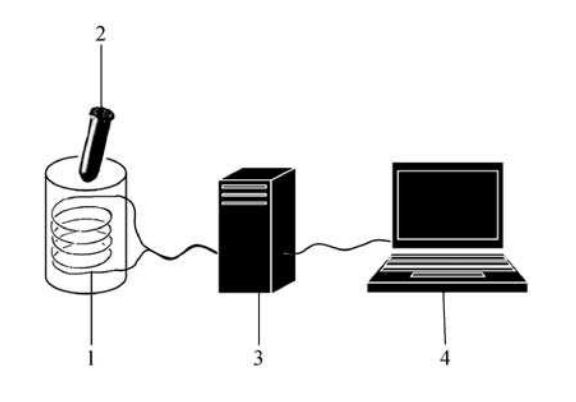
There are several interesting aspects in the physics of the measurement. Most importantly, it is actually rather difficult to transmit and measure these low frequencies, and indeed on this scale it is doubtful whether the measurements are even physically meaningful. Part of the problem is that 7Hz electromagnetic waves have a wavelength of around 42,000 km. Normally, in order to transmit any frequency you might aim for an antenna of quarter of a wavelength, or in this case 10,000km in length. Even strands of DNA are not this long, and anyway they are somewhat folded and therefore self cancelling.

Detection of low frequencies can be managed with small coils as long as they have enough turns, (e.g. 5000 to 10,000) so in principle their equipment might be able to make the measurement, if the DNA had a mechanism to transmit it - which it doesn't.

On top of that, there is very little detail about the equipment used, except a kindergarten-level sketch of a coil, an amplifier and a computer to measure something inside a test tube.

Risible physics!

They do happen to mention the impedance of the coil, which is a start. However, unless that impedance is well matched to the amplifier it means nothing. The connecting cable is incredibly important too. How well is it shielded and what is its impedance and does it match? Then the bandwidth of the amplifier matters. Does it work at all in the frequency range in question, and what is its gain? After that we have to ask how the analogue to digital conversion is carried out. What type of D/A converter is used? What frequency range does it cover? How many bits deep are the data?

But of course the controls that they adopt make all this inconvenient physics irrelevant don't they. It must be true after all! This measurement is not at all like the famous measurement of the faster-than-light neutrinos is it? The two are comparable in the surprising nature of their results, but it has taken many months of professional research for the neutrino problem to have something close to an explanation.

The sentence that I liked best in the paper was "At this point the most critical step was undertaken, namely to investigate the specificity of the induced water nanostructures by recreating from them the DNA sequence".
I can't help but crack a smile!

They make a big thing of Schumann Resonances. They, at least, are a real phenomenon. The lowest frequency Schumann resonance is 7.83Hz, and its wavelength corresponds to the circumference of the earth.  (See first paragraph.) For interest, this link shows the sort of equipment that might be used to measure Schumann frequencies. This paper also demonstrates the measurement difficulties. On page 1 there is a graph of the Schumann frequency peaks.

Schumann resonances - the problems of interference (from here)


They are dwarfed by an interference signal from the Deutsche Bahn (railway). The nearest railway is 30km from the place where the measurement was made!

Case not proven!  Extraordinary claims require extraordinary evidence don't they.

Sunday, 3 June 2012

Distressed or 'in mourning'?

As we are entering the Queen's Diamond Jubilee celebrations, Union Flags are appearing all over the country.  This is not normal in England, where most people quietly get on with the inconvenience of being British without having to demonstrate it to each other.

The unaccustomed national pride belies a certain level of national ignorance that I find to be somewhat surprising.  It seems that a large proportion of British 'subjects' (for we are not honoured with the title 'citizens') are ignorant of the traditions surrounding our flag.  See whether you can spot the difference between this:

Upside down or not?


and this:

Upside down or not?  One of them is wrong.


Can you see it?  The first is the right way up and the second is upside down.  It is all to do with the diagonal white stripes.  At the flag pole, the wide white stripe is above the red diagonal, and the narrow white strip is below the red. The flag really is not symmetrical as a mirror image about either the vertical or horizontal centre-line.  It is rotationally symmetrical, but that is little help when flying it, as the lanyard is at one end.

Driving through a local market town, Abingdon, last night, I was delighted that I did not see a single flag that was the wrong way up.  Sadly, that is not the case everywhere - and YES - I do notice! 

If you are not British (and perhaps even if you are) you might not have known that there is a right and wrong way up, but the fact that not many people notice the error has been useful in history.  It meant that ships could fly a Union Flag (sometimes incorrectly known as the Union Jack) upside-down as a secret sign of distress.  Other British sailors would immediately spot the faux-pas and know that it could not possibly be a mistake.  They might take that as a warning that there was a possibility of an ambush, but the ship's captors would have no notion of the message that had been sent.

If you don't believe me, then in a sense it proves a point.  If you have parents like mine (thanks to my ex-Girl-Guide mother!) the orientation of our flag is so important that it is almost physically uncomfortable when it is not correct.  I am learning to live with this affliction, but it appears to me that a lot of other people have been more successful than me.  Driving around 'loyalist' areas of Northern Ireland where these flags are much more common, I find myself continually irritated by the ignorance of the thugs who have climbed lamp posts in order to fly a flag incorrectly.  How could they be both loyal and disrespectful?

A couple of years ago, one morning as I entered a government site, I spotted that the flag was upside down.  I mentioned it to the site manager whose office was close to mine.  Naturally he denied that it was even possible.  He said that the lanyard was longer on the bottom of the flag than the top, and asked whether the flag had been right at the top of the mast.  His reasoning was that if it had been at the top, then it could not be upside down.  As it happens, I had not noticed how high the flag had been.  However, by coincidence, when I next saw it at lunch time the error had been corrected. 

No more was said about the subject for a few months, but when it happened again I took a photo of the flag with my phone.  I e-mailed it to the site manager saying that, since the flag was both upside-down and at half-mast, I was struggling to tell whether we were in distress or in mourning.

History does not record his reply!

Small note:  With any luck, in two years time, Scotland will achieve full independence from UK (and bankruptcy), and the flag will have to be replaced by another design. 

Two horsemen in Oxford - Dawkins and Dennett

As promised in my post on 11th May, here is the video of the discussion between Richard Dawkins and Daniel Dennett.  Enjoy it and see if you can spot me in the audience!


Saturday, 2 June 2012

Things Christians say: part 17. Free agents!

A weekly series of responses to the things Christians say to atheists, based on the video reproduced here on 30th January 2012.  The aim is to tackle one every weekend, to give both a moderate, polite response to each question ('Piano'), followed by a more forceful rebuttal of the same question ('Forte'). 

They want to be their own free agents - free of any consequences.


Piano

What is a free agent?  Presumably part of the definition includes the concept of free will, so aren't we all free agents in that sense? 

Free will is often used by Christians to explain why there is suffering and evil in the world.  Apparently God gave us free will so that we could choose, and if we were not able to choose to do evil then that free will would not really be free at all.

We are free to act badly and suffer the real consequences in the real world without having to invoke the unprovable concept of eternal punishment in an afterlife as a threat.

***

Forte

Nobody in the world is truly a free agent.  Even the likes of Putin and Berlusconi who undoubtedly have had great power over many years are not entirely free to do anything they like.  They get away with a lot, but still risk punishment.

Moreover, almost all people are required to abide by the law and risk the consequences if they transgress it.  I am talking here of the law and consequences of the country that they live in, rather than 'God's law'.  In order to abide by the law, we do not need a supernatural and well hidden being watching over us, but police.

It is well established that belief in a god does not make anyone more law-abiding, as the proportion of atheists in prison populations is lower that that in the general public.  That claim is often made in USA (where I think the last set of data is nearly 90 years old) but it is also to be found in this recent UK report, as kindly provided to me by Robert Stovold last week.  (Visit his site for some other useful resources.)  He says of that report:

A March 2011 ‘YouGov’ poll found that 61% of people in England and Wales are religious, while the remaining 39% had no religion. Prison Population Statistics published in February 2012, on the other hand, showed that 68.7% of inmates were affiliated with a religion while 31.3% were not. 

The only thing is, certain communities decide that they are going to bound by the law, and yes those communities are sometimes religious and therefore presumably 'better than atheists'!   For example, Sharia Law is seen by them as being above the law of the land, and as such they are attempting to act as free agents.

That is why I want us to have One Law for All - not God's law - not Allah's law, but THE law where nobody is really a free agent in the sense that they get away with their serious misdeeds.


Last week: If you were a Christian and now you are an atheist, you were never a true Christian to begin with.
Next week: Finally we get to claim that Hitler acted 'in the name of atheism'

Friday, 1 June 2012

Build the Enterprise

Frustrated by the lack of manned space exploration during my adult life, I was delighted to come across a web site called "Build the Enterprise".

Someone called "Dan" has spent a huge amount of time on this, producing not only a visually pleasing web site, but a pretty well-reasoned business and engineering analysis of what it would take to put a craft resembling Star Trek's USS Enterprise into operation.

As he says:

Personally, I have found working as an engineer to be very rewarding. The work is interesting, the pay is good, your co-workers are bright and enthusiastic, and the unemployment rate in engineering typically runs under 3% – far below the national average for all workers. For these reasons I hope that some young people find a bit of inspiration in this website, and that this might even help motivate some to study engineering in college.

and in spite of the frustrations of working life and having to deal with unenthusiastic and over-bureaucratic managers, in general I would agree with him.

Just build the Enterprise!  (Credit unknown)


OK - they haven't quite perfected all the details of warp drive yet, but I think they can be forgiven for that.

They claim that this whole project could be completed in just 20 years, at the very reasonable price of US$1 trillion.  At the end of that time the ship would be able to carry a crew of 1000 people on voyages around the solar system.

To quote from the page about the mass and cost of the ship:


For researching, developing, constructing, testing, and supplying the USS Enterprise, along with putting in place the infrastructure on earth and in space needed to support the Enterprise, the cost goal for the Gen1 Enterprise is this: it will cost no more than $1 trillion spent over twenty years.

The Enterprise will be built entirely in space. Thus each component must be launched from earth. This is expensive, and around 35% of the Gen1 Enterprise program budget will be to pay for heavy lifter launch costs (when including both non-recurring costs and recurring costs). These launches will transport not only the Enterprise components into space but also test hardware, Enterprise supplies, and various items needed for space infrastructure.

At the bottom of this webpage is a table showing the detailed cost goals for all components, supplies, infrastructure, and heavy lifter launches for deploying the Gen1 Enterprise. Also included are detailed mass goals for everything making up the operational Enterprise spaceship. But before going into these details, first the overall mass of the ship and its most basic systems needs more discussion.
For the overall wet mass of the Gen1 spaceship Enterprise, a goal is needed. For setting this goal, it’s desirable to be able to tie the goal to some reference point, to something concrete and easy to keep in mind. So we will set the goal as this: Its wet mass (meaning that when the propellant tanks are fully filled) will be no more than the aircraft carrier USS Enterprise back here on earth which weighs 187 million pounds (84,822 metric tons).

The 187 million pound goal may seem arbitrary, but this is not really so. Early roll-ups for estimating the Gen1 Enterprise’s mass were coming in around 200 million pounds. The amount of propellant needed was nearly 100 million pounds of this. As a goal it is very desirable to reduce the amount of propellant needed as a percentage of total ship wet mass because this saves cost and ship mass. Also, reducing propellant as a percentage of the total ship mass frees up room in the mass budget for other ship components. This desire to reduce propellant as a percentage of the ship’s mass creates a program goal for engines to use propellant more efficiently meaning that each engine should have a much higher high specific impulse than typical ion propulsion engines today. So after removing some propellant from a 200 million pound ship mass, 187 million pounds seems like a reasonable goal.

To gain some perspective on a mass of 187 million pounds, consider that a Saturn 5 rocket had a wet mass before launch of 6.6 million pounds. Thus the Gen1 Enterprise will have a wet mass equivalent to 28 Saturn 5 rockets. This is quite large, but it’s also comprehendible [sic]. The Enterprise is a big ship, and if its mass is the same as 28 Saturn 5 rockets, that seems about right.

Good luck to the Enterprise.  Can I book a ticket please? Wouldn't a project like this be just the sort of thing that could encourage an upsurge in the economy and make humanity believe in itself again?

I for one would trade in the Olympic games for the next 20 years as a contribution towards it!