Monday, 4 April 2011

The origin of human rights?

I have often wondered where the concept of human rights emerged from and how it has become so widely accepted in the western world.  This is not to say that I in any way disagree with the concept.  It is just not totally obvious to me where the idea came from.  It does seem clear though that the concept is not from Christianity or Islam, both of which singularly failed to reject many forms of discrimination.

Does the evolutionary trait of altruism stretch this far?  It seems to be altruism taken to the extreme.

I was reminded of these musings while listening to this weekend's episode of the excellent Pod Delusion (episode 78) where Nick Boorer touched on the topic.  I get the impression that he is not a fan of Italian society, but setting that aside he told an interesting story, paraphrased below.

The Grand Chamber of the European Court of Human rights recently judged that the compulsory presence of crucifixes in Italian classrooms does not consistitute a violation of Article 2 of the First Protocol to the Eurpoean Convention on human rights.  How did they decide this?

They confirmed the judgements of the Italian Supreme Administrative Court.  It said that he modern principle of secularism and the importance that that principle was granted in Italy and in Europe was entirely predicated upon, and a direct product of Christianity and Europe's inherently Christian heritage.  The values the enlightenment espoused, liberty and freedom of every person, the declaration of the rights of man and ultimately the modern secular state are all based on the Christian concept of the world.

That might be legally true but I find it hard to accept that it is literally true.  As I always say - "In the EU there is no smoke without mirrors".

Abrahamic religions require the utter submission of one's moral conscience to one ultimate authority and explicitly reject tolerance and in fact demand discrimination

One mystery remains.  Which of the items on the Pod Delusion was the April Fool joke?  I'm pretty sure it was not this one though, as the topic was covered by the Religion Law Blog on March 21st.

Sunday, 3 April 2011

When was the flood?

In the calendar developed by Archbishop James Ussher (who calculated that the world was created in 4004 BC), Noah's flood happened in 2348 BCE.

By comparison, there are Bristlecone Pine trees alive today that are dated to be 500 years older than this.

Of course there are many ancient stories of 'the flood' from different cultures.  Some are almost certainly older than the Old Testament version. Which one should we believe in if we don't accept that the bible is the literal word of god?

But more importantly where did all the water come from and where is it now?  And how did the koalas and kangaroos get back from Australia to get on the ark?  Or maybe they weren't there in Australia originally, but why did the amazing rafts of floating vegetation take the koalas and kangaroos only to Australia after the flood and not leave their kind anywhere else along the way there.

How can anyone really believe in this as a rational literal story? The fact that some people do believe it only strengthens my disbelief.

Saturday, 2 April 2011

Absence makes the heart grow fonder

Or perhaps it should be "Abstinence makes the church grow fondlers.".

Friday, 1 April 2011

TICKETS: Richard Dawkins and Sam Harris – Oxford, Tues 12 April

Wow - tickets for this event were released this morning and as feared the BHA's server seemed to (shall we say) struggle a little with the demand.  After 30+ minutes of frustration I was disappointed not to have managed to buy any tickets even though I had had them half-bought three times.  The message was that they had sold out.  Result = spoilt morning!

Fortunately the sales server seems to have confused itself and later 'realised' that it actually hadn't sold the tickets that were in people's shopping baskets because it hadn't let them pay for said tickets. 

I just managed to buy some after all.  The day is saved.  It all goes to show how popular the New Atheists are. 

I must remember to take a cushion to sit on.  As far as I remember, the Sheldonian has some of the most uncomfortable seating in the entire world!

RINSE2 - homeopathic project management

A new project management rationale, based on a revision of the age-old technique of 'Homeopathic Project Management' (HPM), is being pioneered by the UK Government. A two-week training course* will have to be undertaken by anyone running projects for the government. The course will introduce them to the complex new terminology associated with this powerful technique. Replacing the current 'standard' PRINCE2 it is being presented under the pseudonym RINSE2.

Although government organisations have spent many years prevaricating over this idea, you have to admire the simplicity of HPM. In essence the idea is to dilute the resources allocated to the project, followed by thoroughly shaking up the organisation.** The principal technical terms 'dilution' and 'succussion' are new to project managers, but it is claimed by proponents of the technique that the more often they are carried out, the greater the efficaciousness.

Taken to the extreme, there is nobody left in the organisation who knows anything useful, but this helps senior management to drive the project to completion with significant cost savings. Furthermore, if applied correctly there is nobody left to assess effectively whether the completed project has any outstanding deficiencies. This has been found to be a great advantage.

The well-known outspoken author and critic of the analogous homeopathic medicine, Simon Singh, has been notably silent on this topic and this is seen as encouraging news by those who back the initiative.

RINSE2 represents the way that future government efficiency improvements are expected to be delivered and in carefully selected trials it has been found to be at least as effective as the better-known homeopathy. ***.

Press release date: 1st April 2011

© Something Surprising Blog


Notes for editors:
* Training to be provided by 'experts' carefully selected over a series of well planned, lavish business lunches.
** Beating everyone with a leather bound book has been shown to increase the effectiveness further, but only at the cost of legal fees in employment tribunals.
*** Homeopathy has been shown to be no better than placebo but in spite of this it is foreseen that RINSE2 will live up to similar expectations.

++ The previously favoured 'PRINCE2' is now consigned to the same fate as the National Health Service.

Thursday, 31 March 2011

Might religion go extinct?

A surprising new paper was presented at the recent meeting of the American Physical Society.  I know a lot of engineers and physicists, but none of them are studying the decline of religious affiliation in 85 regions around the world.  However Daniel Abrams, Haley Yaple and Richard Wiener have been using techniques from the field of statistical mechanics to do just that.

They start with the observation that people claiming no religious affiliation constitute the fastest growing religious minority in many countries throughout the world. Americans without religious affiliation comprise the only religious group growing in all 50 states.  They claim their model predicts that for societies in which the perceived utility of not adhering is greater than the utility of adhering, religion will be driven toward extinction.

It is not hard to believe that this could apply to some of the better-known secular countries such as The Netherlands, but it seems more surprising that the trend in Ireland indicates that it is going the same way.

Meanwhile, during a lunchtime discussion with two Portuguese colleagues recently, they assured me that Portugal is a Catholic country, but that it hardly mattered as they largely ignored the teachings of the church.  I had to disagree about whether it mattered, but that news is not altogether discouraging.


Here is a link to their paper.  Sadly it fails to pass the 'two equation test' and reminds me that I earned my physics degree in spite of my lack of expertise in statistical mechanics!

Wednesday, 30 March 2011

Another £25 billion lost to us?

"Some £25bn every year is thought to be lost to the public purse by wealthy tax avoiders. This money needs to be recouped to help save our essential public services."

This is the claim of the 'demonised' UK Uncut organisation which occupied Fortnum and Mason last Saturday, 26th March.

Whether this figure is exactly correct or not, it is perfectly clear that the wealthiest people pay the least tax in UK.  If they accidentally paid as much tax as I do (in £, not in %) I suspect they would probably sack their accountants.

(Am I ranting too much on a single topic this week?  Leave a comment if you think I should return to my usual rants - or indeed if you think this stuff matters a lot.)

Tuesday, 29 March 2011

Obscene wealth

This picture from the march in London says it all.


Of course out millionaire ministers wouldn't want to do anything to make this fairer.

Monday, 28 March 2011

Tax is for the little people

Its only fair to ask that the wealthiest people in UK pay their share of taxes.  Isn't it?  Nobody is asking for anything punitive - or at least not more punitive than the rest of us have to put up with. But how can Phillip Green be allowed to get away totally tax free with a UK income like his?  It is just not fair!

This picture is from the 26th March protest in London.  Does it remind you about the quotation from Cardinal Ratzinger that I posted a few days ago?


We seem to be left with a few options:
  • Do nothing at all and ask people why they think it is worth doing anything. i.e. Just give in!
  • Do something - like attending the protest as a lot of us did - i.e. Exercise our democratic right to protest!
  • Sympathise with those who are indulging in a campaign against the likes of Vodafone and Top Shop.  i.e. Conspire to commit a crime if only a thought-crime.
  • Take action with them because the first two items on this list clearly make too little difference.  i.e. Criminal activity albeit maybe for a just cause.

Now I personally feel my opinion to be right in the middle of this list, somewhere in between attending protests and supporting direct action.  I don't like the idea of criminal damage being caused but I do recognise that even 4 to 500,000 people parading through London can simply be ignored by our barely-elected government.  (It is still claimed by BBC to be only 'quarter of a million'.  I'm pretty sure that is an under-estimate.)

There was something just slightly satisfying, even to law-abiding professional me to see this mess on the windows of De Beers in Picadilly.  I have no idea of their tax status (although I think I could guess) but they are clearly associated with a certain part of our society.  I would like them to be made to feel the outrage that I am feeling now.


"23 of our ministers are millionaires" I read yesterday.  Snouts in the trough eh?  If we 'little people' don't start to make our voices heard more clearly they will continue to get off scot-free.

Sunday, 27 March 2011

On the performance of the BBC

With regard to the march in central London today:

  • It is my impression that the BBC downplays any criticism of the government
  • I feel that they dwell on the sensational stuff in Trafalgar Square last night
  • 399,700 people are back at home peacefully - vs 300 left in Trafalgar Square
Who gets on the late-night news?  Answer - the 300.

Let's hope for cutbacks that eliminate the BBC!  Spokesperson for the UK government or what??

Saturday, 26 March 2011

March for the alternative

March 26th - the march for the alternative to the government cuts in London.  Estimates of the number of people attending vary but my colleagues and I side with the Guardian's estimate of 400,000, (based on various evidence from the number of coaches and trains to the sheer time it took to move along the march).  I can tell you one thing for certain.  The centre of London had traffic problems!

OK - say 100 people got excited and attacked some shops - shops that arguably deserved it as their owners pay effectively NO tax in UK.  But that leaves 399,900 people - all the people I actually saw in 6 hours included - who were there because they care what happens to the UK.  The atmosphere was uplifting.  There really is hope for humanity.

Just imagine - the cost of bailing out the banks recently is actually greater than the total amount that the government has spent on science since WW2!!  And we continue to pay bonuses to the bankers because they are ??good?? at it?


How do I choose just one photo from today?  The answer is that I just can't choose one.  The two that I have chosen show the good natured humour of an excellent day in London.


Now - regular readers will understand that I do not normally worship the police.  But today I can't offer enough praise for the soft touch that I observed.  The officers I spoke to were polite and sympathetic, guiding the protesters along the correct route but allowing tourists to go about their visit to London.  Well done to 'the Met'*!

* For readers outside UK - 'the Met' means "The Metropolitan Police", in London.

Christian terrorists all around us?

One aspect of terrorism has been defined as "use of threats of violence for the purpose of creating fear in order to achieve a religious goal".

This sounds like Christianity - "Believe this or burn for eternity!"

On this opinion I do agree with the great Hitch!

Friday, 25 March 2011

Was hell 'invented' by gentle Jesus?

What are the origins of the concept of hell? Christopher Hitchens claims that in the Old Testament there is effectively no concept of hell in the modern sense. The idea of eternal suffering was only brought to us by 'gentle Jesus meek and mild'.

Of course Islam also has a concept similar to that of the christian hell, and it is called Jahannam. The origin of this word is thought to be from the same root as the Hebrew name Gehenna which was originally the name of a valley near Jerusalem. It was a place more like the Catholic concept of 'purgatory', and in Jewish tradition nobody would stay in Gehenna for a period longer than twelve months.

Gehenna is often translated into English as hell. However the King James version of the bible also translates the words 'sheol' and 'hades' as hell.

The Jewish meme of 'sheol' is sometimes translated to Greek as 'hades'. All the dead go there, regardless of their moral choices in life. Sheol predates all christian and muslim ideas of judgement and it is considered to be totally different from heaven and hell.

Even within one faith there are disagreements. For example, in Acts 23, verses 6-8 the Pharisees and Sadducees were unable to agree whether angels and spirits even exist, let alone where the spirits go after death.

Confusion reigns. If theologians cannot agree about the subject then surely it is futile to worry about it. Even within the three great mono-theistic religions followers are required to take different actions to avoid eternal damnation, so on the basis of this it is clear that the majority of people will be wrong and suffer the consequences.

Much as I hate to disagree with the great Hitch, I think his explanation might be a little simplistic.  But its a good story and vaguely true.

Thursday, 24 March 2011

Simple christianity

“The Christian believer is a simple person: Bishops should protect the faith of their little people against the power of intellectuals”  -  Cardinal Joseph Ratzinger (now the pope of course).

If this offensive quotation had come from one of the new atheists I suspect that few christians would have been surprised. 

Perhaps we should give him the benefit of the doubt.  Maybe his meaning was lost in translation?  (Well OK, maybe not.)  Ratzinger wouldn't want to confuse his 'little people' with actual facts would he?

Wednesday, 23 March 2011

The Peace of Cod

An American christian friend has just bravely launched a new blog and I was reading the first few entries.  I was so glad to read the moving story of her daughter's first conversation and feel very happy for her.

However, her post "At his feet" described the peace of submitting yourself entirely to Jesus, and was less moving to me.  Gospel music like the linked song always did make me feel uncomfortable too - part of my de-conversion I think.

As I think she was effectively inviting me to comment, I posted a description of finding peace by escaping from the absolute tyranny of the 'less cuddly' aspects of a god like hers.  Hopefully it was polite - just as her comments here have always been courteous.  I feel I can be slightly more direct here on my own blog and can drop the capital letters for deities and religions.

I was reminded of that lovely prayer that begins "The Peace of God that passeth all understanding . . .".  I always liked it - but now I wonder whether that is partly because it indicated that the end of the service was imminent.  Those words describe my thoughts more vividly now than they ever did when I was a christian. (small c!)

Now on the other hand, the 'piece of cod' that I had for dinner this evening with chips and tartar sauce was quite delicious.

Small link: On a slightly less controversial note - see Authentic Fish and Chips - an English delicacy!

Tuesday, 22 March 2011

Vexed by demons

According to Carl Sagan, in his great book "The Demon Haunted World", 1996 (p116), St Augustine was 'much vexed with demons', which prey on the 'captive and outwitted minds of men'.  These demons have a striking similarity to the activities of the aliens who seem to abduct so many Americans in these times.

Augustine believed that witches were the offspring of the forbidden unions between demons and women.  Demonic seducers of women were known as incubi, and of men succubi.

"There are cases in which nuns reported, in some befuddlement, a striking resemblance between the incubus and the priest confessor, or the bishop, and awoke the next morning to find themselves polluted just as if they had commingled with a man".

There is nothing new in the World!  Ask Pope Benedict about it.  No seriously, ask him!

Monday, 21 March 2011

Facebook's 'A' week event

Atheists in Facebook have been invited to change their profile picture for this weekend join an event that you can find by clicking on this link.


Strangely enough I found that a lot of my contacts there have changed theirs.  Wonder why.  The idea of 'A' Week seems to be going down well with over 17,000 people liking it so far.

Sunday, 20 March 2011

The Forer Effect

The Forer Effect, (or as it is sometimes known, the Barnum Effect) gives a little insight into one of the tools used by psychics in 'cold reading' where they can convince their 'victims' that they know more than they really do, and use that knowledge to gain even more knowledge from the victim's reaction. See how appropriate this seems as a description of yourself.

"You have a great need for other people to like and admire you. You have a tendency to be critical of yourself. You have a great deal of unused capacity which you have not turned to your advantage. While you have some personality weaknesses, you are generally able to compensate for them. Disciplined and self-controlled outside, you tend to be worrisome and insecure inside. At times you have serious doubts as to whether you have made the right decision or done the right thing. You prefer a certain amount of change and variety and become dissatisfied when hemmed in by restrictions and limitations. You pride yourself as an independent thinker and do not accept others' statements without satisfactory proof. You have found it unwise to be too frank in revealing yourself to others. At times you are extroverted, affable, sociable, while at other times you are introverted, wary, reserved. Some of your aspirations tend to be pretty unrealistic. Security is one of your major goals in life."

Forer's example seems to apply to most of us, and in his experiment people were asked to rate how accurately they felt it described them. The average score was more than 4 out of 5. The Forer effect is the observation that individuals will give high accuracy ratings to descriptions of their personality that supposedly are tailored specifically for them, but are in fact vague and general enough to almost anyone.

Saturday, 19 March 2011

Probability taken personally

A rationalist view is that 'luck is just probability taken personally'.

Sadly I can't attribute this as the author has remained somewhat elusive.

Friday, 18 March 2011

A couple of quotations

There have been no anti-religious posts here recently, so these go a little way to make up for that.

"The lion may lay down with the lamb, but the lamb won't get much sleep" - Woody Allan

"Just because you're offended doesn't mean you are right." - Ricky Gervais

Thursday, 17 March 2011

Not ghostly spirits - just proof!

Until 1 January 1980, the United Kingdom defined alcohol content in terms of “proof spirit”, which was defined as the most dilute spirit that would sustain combustion of gunpowder.  It was found that gunpowder would not burn in rum that contained less than 57.15% abv.

Therefore, rum that contained this percentage of alcohol was defined to have "100 degrees proof".  Spirits with a lower alcohol content were described in terms of percentage proof or degrees proof.

More than 30 years later (in these days of standardised alcohol percentages) you still hear people talking about  spirits in terms of the proof spirit definition.  How many of them know what it means?

Wednesday, 16 March 2011

Gallows humour

When William Palmer, English 19th century doctor and convicted poisoner, stood on the trap door of the gallows in 1886, his last words were "Are you sure this is safe?"

Tuesday, 15 March 2011

Why are wrist watches so accurate?

Wrist watches only contain standard quartz crystals but many people observe that they seem much more accurate than clocks in other environments (like the car).  The answer is probably temperature control.  It is close to your skin which has a very constant temperature compared with other places.

Monday, 14 March 2011

Fire Walking

Fire walking is a remarkable spectacle and looks very dangerous. So how does it work when it is obviously not a case of mind over matter or anything paranormal?

The key lies in the very poor thermal conductivity of the charcoal.  As long as you only touch the charcoal, however hot it is, the surface cools so quickly that it does not burn you, and the heat is not conducted from inside the charcoal to the surface quickly enough to be a problem.

By analogy it is like a cake in a tin in the oven.  You can touch the cake with your fingers to see whether it is cooked, but even touching the tin for the briefest possible moment you will be burnt.  Haven't we all done that?

Mind you - even understanding all that I'm not sure I want to try fire walking.

Sunday, 13 March 2011

The UK census 2011

The time for the national census is nearly upon us, and nobody living in the UK can be unaware of the furore about a few of the questions.  A sentence containing 'storm' and 'teacup' comes to mind. 

Do I care whether the Welsh are being asked whether they speak Welsh or not.  Not a jot!  (Nor even a tittle.)  I smile as I wonder how many people in England actually speak English though.

The religion question is a little more interesting, but still hardly earth-shattering.  An article in The Guardian's series called 'Face to Faith' nicely summarises this week's 'fuss' about some posters being banned from railway stations .  You can find all three posters here.


I loved one of the comments on the Guardian page above.  Asterixorb said:

"I find signs outside churches that say things like 'Jesus saves' 
nonsensical and offensive.  Who do I report it to?".

Saturday, 12 March 2011

Japanese earthquake

Speaking of quacks, I hear that people are blaming a so-called 'supermoon' for the dreadful earthquake.


I had the pleasure of visiting Sendai a few of years ago and found the people there very hospitable.  If any country in the world can deal with this catastrophe calmly and efficiently then I am sure it is Japan.

This supermoon idea is just nonsense.  The moon and sun together exert a greater force on the Earth at full moon and new moon. The evidence for this is that you get 'spring tides' at those times.

Just at the moment we are a few days from new moon and I just checked the tide tables and see that the tides are not unusually high due to this impending 'supermoon'. Even if they were, they would have been higher a few days ago, at new moon.

Incidentally, the next full moon will bring tides among the highest in the year as the equinoctial spring tides are always the highest - and a great time to see the Severn Bore if you live near enough.

Tidal forces on the oceans can't be different from tidal forces on the Earth's crust. That means that according to the hypothesis of the Daily Mail the earthquake was several days too late.

In other words - the hypothesis is demonstrably hopeless.

Friday, 11 March 2011

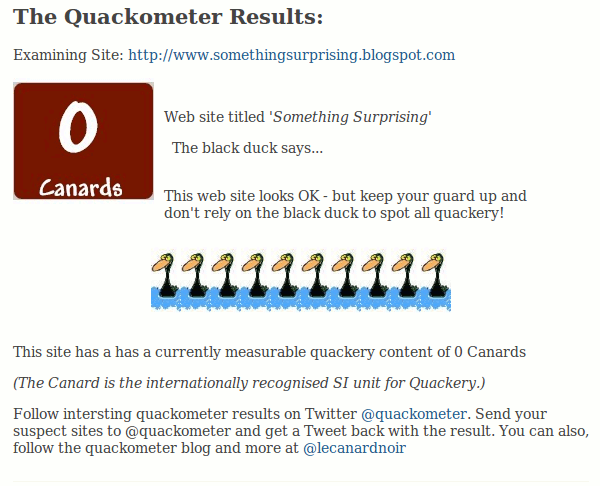
The Quackometer - passed!

Just finished reading Simon Singh and Edzard Ernst's excellent book 'Trick or Treatment' and enjoyed it.  Somehow they managed to say that it is irrational to believe in most forms of alternative medicine without making me feel stupid for having fallen for a few homeopathic scams in the past.  I am now fully converted to the anti-homeopathy brigade.

Its funny how you can read a book like that, find a name you know, and realise that you have recently made the acquaintance of someone who is quite famous.  This came in the form of a reference to Andy Lewis's website 'The Quackometer' which claims to be a contribution to the automatic debunking of quack medicine on the net.

So - did it work?  I tested it on this blog and on my other technical web site and was relieved to find that I got a score of zero quacks on the international scale of quackery for both.  Phew!


Just to convince myself it worked I tried the British Chiropractic Association too.  They score 8 quacks.

Going to read Richard Wiseman's new book 'Paramormality' next.  The first few pages have been gripping.

Thursday, 10 March 2011

JREF's million dollar challenge just got easier

The James Randi Educational Foundation (JREF) has for many years offered a large cash prize for anyone who can prove that they can use paranormal skills.  At present the prize is $1 million. 

The claimant has to agree the terms of the test in advance.  Of course all of them fail (so far at least) and then some of them claim that the test was unfair after all.

The qualifications for entry into the testing process have just been changed to make it easier as you can see at  JREF’s $1,000,000 Paranormal Challenge Now Easier Than Ever

Wednesday, 9 March 2011

Douglas Adams on the Scientific method

"Now, the invention of the scientific method and science is, I'm sure we'll all agree, the most powerful intellectual idea, the most powerful framework for thinking and investigating and understanding and challenging the world around us that there is, and that it rests on the premise that any idea is there to be attacked and if it withstands the attack then it lives to fight another day and if it doesn't withstand the attack then down it goes. Religion doesn't seem to work like that; it has certain ideas at the heart of it which we call sacred or holy or whatever. That's an idea we're so familiar with, whether we subscribe to it or not, that it's kind of odd to think what it actually means, because really what it means is 'Here is an idea or a notion that you're not allowed to say anything bad about; you're just not. Why not? - because you're not!"  - Douglas Adams

He wrote long sentences didn't he!
Thanks to the Pod Delusion special about Douglas Adams for the first half of this, which led me to find the entire quotation.  I liked the last part and have heard Richard Dawkins quote it on videos on Youtube but had forgotten where it came from.

Tuesday, 8 March 2011

Identity theft for real

A colleague of mine was surprised last Friday when a brand new Iphone 4 (worth about £700) was delivered to his house by DHL.  Later in the day there was a phone call from someone claiming to be from DHL, informing him that they had delivered it in error and that they would send a representative to collect it.  This 'representative' turned out to be a man in a white 1999 registered van with no form of identification to link him with DHL.  (Yes the registration number has been recorded.)

My colleague should be congratulated on spotting a potential scam and he refused to hand the package over.  Instead he called the mobile phone company, O2, who were unhelpful.  Apparently he had to be able to answer his security question - that being the one that had clearly been set up for him by someone else, using his bank account details.  He has not had any dealing with O2 for several years.

Similarly his bank(s) have all been unhelpful and rather uninterested in the event.  Admittedly none of them have yet seen any transactions, but one might have hoped that they would be keen to spot potential fraud and take appropriate actions.  The police have also taken the details and said that they would send an officer around to collect the phone.  My colleague (I think reasonably) has declined to hand it over.   What would be the point when it has never been in the possession of the fraudsters.


The best help he has received so far is from DHL who apparently have to deal with this kind of thing on a regular basis.  At least they were able to reassure him that his case is not without precedent.  That must be some relief to him at least.

It is assumed that this has been perpetrated by someone with access to my colleague's address and bank account details, that they would have collected the phone and then sold the stolen goods.  Not an especially clever scam!  But a worrying case of identity theft!  I could easily imagine many people falling for it - even if as intelligent as my readers. Watch out for it. 

This is not one of those stories that is 'nth hand' with an unattributable source, although of course as soon as I tell anyone else it becomes like that.  Just beware. 

Monday, 7 March 2011

Tittle

As promised yesterday . . .

A tittle is the dot on a lower case i or j. It first appeared in the 11th century. Some languages (e.g. Irish) omit the tittle from the i.

[My mother used to use it as a term of derision if she didn't believe a story that was being told to her.  "Tittle" she would exclaim.  Haven't heard her use the term for a while now.]

Sunday, 6 March 2011

Do Old Testament laws still count?

So often when you quote an inconvenient part of the Old Testament to a christian, they will tell you that it has been replaced by the teachings of Jesus and that Jesus came as saviour for us all etc.

If the OT really has been superseded then surely the ten commandments are also superseded, and the evidence suggests that this is not at all what they want. That is not to say that the 10 commandments have much to do with today's laws or morality when looked at critically. More of that another day soon - a post on that topic is at the planning stage.

Why is the Old Testament still there in the bible? Because it foretold the coming of Christ. (Or maybe the whole Jesus story was built up to fulfill the prophecies. More on that another day perhaps.)

So, how do we know that this is true that the OT has been superseded? Is it true that its inconvenient laws no longer apply? Maybe it is in the words of Jesus himself. Let's look at the book of Matthew.

5:17 Think not that I am come to destroy the law, or the prophets: I am not come to destroy, but to fulfil. [So the context is OK then? If in doubt you can look it up yourself. It is just after the bit about everyone being 'Blessed' that was mocked so well in Monty Python's 'Life of Brian'.]

5:18 For verily I say unto you, till heaven and earth pass, one jot or one tittle shall in no wise pass from the law, till all be fulfilled. [Not much doubt then. Not one jot to be changed. Presumably this applies to all the 613 commandments in the Torah, which are represented in the Jewish 'Halacha'. Incidentally what is a tittle? See tomorrow for the answer.  Here's a link added later!]

5:19 Whosoever therefore shall break one of these least commandments, and shall teach men so, he shall be called the least in the kingdom of heaven: but whosoever shall do and teach them, the same shall be called great in the kingdom of heaven.

Note to self! Must remember not to boil any goat kids in their own mother's milk then. (This is the tenth commandment if you read the version in Ex. 34:26 and you can also find it in Deut. 14:21)

Saturday, 5 March 2011

The 'Four Jokes'

It is said that ALL jokes can be broken down into a combination of the following.

1/ Incongruous or surprising
2/ Puns and plays on words
3/ Exageration
4/ In jokes

Can you find one that does not?

Ok - I can't resist trying to give a one line example from memory of each.  I challenge my readers to come up with four better one liners (which shouldn't be difficult

1/  How does it change many dyslexics to take a light bulb?
2/  Famous football result - East Fife 4 - Forfar 5!
3/  I've told you a million times not to exagerate!
4/  Fusion power is 30 years away and always has been.

(Incidentally, there is a credible answer to the last one!  Must post it in the next week or so.)

Friday, 4 March 2011

Aid for emerging nuclear powers?

Should we, as UK tax payers, really be sending aid donations to Pakistan, a country where it seems to mean inevitable death to be a public figure who is not Islamic?  The 'religion of peace' strikes again, with the murder of the only christian in their cabinet, apparently for trying to change the country's blasphemy laws.

The thing that annoys me is that by paying my taxes I am partly subsidising a country where barbaric acts like this seem to be acceptable.  I am no happier that we are also giving aid to India.  Sorry folks, but if you can afford to develop nuclear weapons then surely you can afford to feed, clothe and even educate your people.  Of course they both could afford it but they choose not to.

Meanwhile in UK, the government is cutting back on everything except overseas aid which is ring-fenced.  Isn't it time we took a serious look at this policy?

Thursday, 3 March 2011

David Colquhoun in Oxford

A good crowd (50 or 60 ish) gathered at the Oxford Skeptics in the Pub event last night, to hear Professor David Colquhoun, but I would estimate that about 25% quietly left at the interval.  Tempted to do so myself, I'm glad I stayed as the questions and answers were a little more interesting than the talk.

Although I would say that I agree with his campaign against Complementary and Alternative Medicine (CAM), and agree with his consistent campaigning on the subject, I found the accounts of the events a little more disparaging than might have been necessary.  (Of course he was describing his hard won victories and wanted to describe them in detail.)

The slides contained a lot of text and the audience had little chance to read some of them, and I would just say that his method of presentation was 'unusual' for a professional speaker and member of the Royal Society.  I admit that there were a few giggles, including the surprising inclusion of the National Health Service's formal job specification for a 'Spiritual Healer'.

After last week's excellent event, (Paula Kirby), tonight was more than a little disappointing.  Hopefully the April event with Trystan Swale from the Righteous Indignation podcast will be more fun.

Wednesday, 2 March 2011

Wisdom of Dennett

When asked "Don't you believe in a transcendent force that governs everything", the ever-incisive Professor Daniel Dennett replied "Yes I do.  Gravity"

Tuesday, 1 March 2011

The 'arrogance' of the New Atheists? What arrogance?

I have taken a little flak in the last week about attending a series of meetings in Oxford.  One of the accusations was along the lines of "how can these people have the arrogance to tell others what to think" followed by the almost inevitable "I'm offended that you seem not to have any respect for my beliefs".  There was more, but this conveys the flavour of the conversation.  The fact that my accuser had not attended any of the said meetings was apparently not relevant.

And yes, I did say 'conversation', even that that sounds quite one-sided.  I have found in recent years that it is best to hold my tongue because my few attempts to reply have made matters even worse.  (The accidental use of the expression 'bronze age myths' a few months ago did not go down too well!)  I didn't even think quickly enough to use the defence that we were not hearing about what to think, but more how to think.

I'm not sure whether my developing thoughts are the result of listening to inspiring speakers this week, and meeting some of them in person, or whether I am beginning to recite the new atheist mantra without realising it.  I am definitely getting fed up of my idealogical heroes being called arrogant though.

So . . . thinking out loud . . . what about:

1/ The clergy-man standing up in the pulpit every Sunday and preaching what to think?  Is that somehow better than what I have been hearing?  If this sermonising is not arrogance what is it?

2/  Prayer groups meet every day within a few minutes drive of my home.  I don't go round knocking on the doors of the participants and telling them how offended I am by their gatherings.

3/  Bible studies take place in our parish regularly.  And yet they only seem to study the 'nice' verses in the old and new testaments.  Isn't that telling each other what to think?  (Or teaching each other which bits not to read?) It is definitely not about how to think.

4/  Finally for now - bible reading notes have been a pet hate of mine for many years, even when I was still a Christian.  Whenever I have picked up a copy of 'Guidelines' or another of those platitudinous little booklets I find phrases that make my flesh crawl.  Picking one up now, and opening it at random I read "It is the duty of every Christian, like a lawyer in a court room, to be able to respond to the questions of non-believers coherently and persuasively".  I hope none of them ever have to represent me in court then!

So which side is the greater purveyor of arrogance?  OK, some of the New Atheists are more outspoken than others.  But this week I have heard no ranting from the pulpit (and certainly I have heard that in churches).  I have just enjoyed the reasonable and well presented opinions of reasonable women and men.

Monday, 28 February 2011

I respect your religion!

"We must respect the other fellow's religion, but only in the sense and to the extent that we respect his theory that his wife is beautiful and his children smart."
H L Mencken

He also said "People say we need religion when what they really mean is we need police".  

I would say that we need a police force with a little more humility.

Sunday, 27 February 2011

Oxford Think Week - Education

Samantha Stein's talk about the educational ideology of Camp Quest UK drew a slightly smaller audience than the others I have attended this week, but was nonetheless interesting and very well presented.

She asked why she had had to wait until she was 19 to learn 'the scientific method'.  As she said, the combination of the scientific method, critical thinking and philosophy would help anyone in their search for facts.  These skills would help you to distinguish fact from fallacy while browsing the internet.

And yet schools concentrate on fact-based learning rather than learning to understand.

Even in a Physics degree course I'm not sure I learned about the scientific method.  I picked it up somewhere in my 30s and 40s.

Saturday, 26 February 2011

Oxford Think Week - Consiousness

A gentleman in the audience began his question with "Speaking as a geologist, your arguments are largely incomprehensible to me . . ." and I can only agree with him.

The most incomprehensible arguments came from Raymond Tallis who tried to persuade us that neuro-science will never be able to explain conciousness.  Although he was an erudite speaker, looking through my notes I find almost nothing to say except that I think I prefer Daniel Dennett's well reasoned views on the same topic.  Dennett's "Consciousness Explained" was quite challenging, but this speaker was impossible (in the nicest possible way).

The other side of the argument was presented by David Papineau.  At least I could grasp the basics of what he was talking about!  He believes that there is a chain of causation relating to consciousness.  The fact that we want to know why a certain brain activity feels as it does (e.g. the feeling that something is red) just shows that it is hard to rid ourselves of dualism (separating the mind from the brain).  He argued that there is no such separation.  Non-dualists don't even need to ask why certain brain processes give rise to conciousness.  They just are the feelings.

Now it is quite possible that I got all of that completely wrong.  Still, wearing my Fusion sweatshirt I got the chance to evangelise fusion to a bright young physicist.  The evening was not totally wasted.

Friday, 25 February 2011

Oxford Think Week's disappointment now celebrated!

This evening's event in Oxford Think Week was somewhat challenging to my own inadequate consciousness.  As someone said, I wished we had had Prof. Peter Atkins there tonight!  More on that tomorrow.

But the good news!  Tuesday evening's disappointment has been largely mitigated by the team from "The Pod Delusion".  Thanks guys!  The discussion between Richard Dawkins and A C Grayling is now available at the web site for The Pod Delusion - one of my favorite podcasts.  It was fascinating to listen to it and decide for myself how successful this 'experiment' might be. 

Several people had told me that it was a 'bit of a love-in', with RD and ACG agreeing with each other on everything, and with the audience there just to 'worship' them.  They told me that they would have liked to hear some other points of view.  They told me that it was a bit like a religious experience except that the two preachers were atheists.  (Yes honestly someone said that!)  They were preaching to the choir.

My take on that is substantially and radically different.  I thought it was a really good way to hear the considered, consistent and complementary views of two great thinkers without the clamour of non-existent controversy.  As non-religious people, surely we have a right to a discussion that is not contaminated by supernatural mumbo-jumbo.  Christians go to church and agree with each other every Sunday.  We should have a chance to do it too, and religious apologists have no right to be offended about that even if it is a public event (like most church services).

I'm not saying that we should start to take offence at the insistence of religious people to interrupt our serious contemplation.  I'm just claiming that we have a right to enjoy  rational thought together sometimes, free of the rantings of religious apologists.

Let's have more like this - please??

Think Week goes from strength to strength

Oxford Think Week's evening event for Thursday was a surprisingly entertaining discussion between Professor Peter Atkins (Chemistry) and Professor Steven Law (Philosophy).  Can Science Alone answer our questions?

This was far from the dry debate that it could have been if we had not been so fortunate.  It was the most interesting, thought provoking and entertaining event I had attended since . . . well . . . Wednesday!  This week is a veritable feast.  If I try to keep this post short, do not take that as a lack of enthusiasm but more a sign of typing induced stress!  (Or maybe it is a lack of intellectual stamina?  But in saying that I think of the words of a friend who tells me sometimes that I am "indulging in another bout of self-deprecation".  And although English is not her first language I would trust her as a proof reader any day!)

Professor Atkins was clear from the outset.  There are three ways of acquiring knowledge:
  • Reading ancient texts (Religion)
  • Thinking (Philosophy)
  • Experimenting (Science)

Theologians obfuscate, nobody else is quite sure what Philosophers do (but it tends to end up in circular arguments), and Scientists illuminate.  But we have to distinguish real questions from empty questions.  Science can't yet answer all questions but that doesn't mean that it never will, and the progress of the last 100 years has been amazing compared with 10,000 years using the other two approaches.

Professor Law started by saying that he was a great admirer of the empirical sciences.  He regards them as a great tool, and possibly the only tool we have.  He thought that some questions were impossible to address in principal, but that didn't mean that they were off-limits. He had the impression that the majority of scientists were not so wedded to the idea of scientism and gave a few examples of questions that were conceptual rather than scientific.  (One was the example of Galileo's thought experiment about dropping a heavy and a light ball and deciding which would fall faster, and how that would be affected if they were joined together.)  He wanted to separate the 'is' questions from the 'ought' questions and suggested that you cannot logically get an 'is' out of an 'ought'.

I expect I am showing my slight bias by commenting that although he might have convinced some members of the audience (about 100 interesting people) he failed totally to convince his opponent.  For example, just because the answer is intuitively obvious, it does not mean that the result of an experiment will not surprise you.

Another big question, "Why was the universe created?" might not be a sensible question because it pre-supposes purpose.  Perhaps we should ask How instead of Why?

Obviously there is no conclusion, but I think I land on the side of scientism and enjoyed the journey.  What a wonderful evening with an opportunity to meet people I have admired from afar, and to look suitably foolish in front to them.  (I wish I had told Richard Dawkins how big an effect 'The God Delusion' has had on my life, and that I only read it because our vicar recommended it to my wife (who remains thoroughly Christian)!  Ho hum.  Maybe next time.)

As usual - failed to be concise in this post!  Whoops.

Thursday, 24 February 2011

Royal Bank insanity - and we put up with it!!

Too many surprising things are happening this week, but I can't stop myself on a few topics.  I'm easily exceeding my normal daily quota of one surprise!  This evening's earlier post was scheduled and I just forgot to reschedule it!  Never mind.

Today's news about the Royal Bank of Scotland making a loss of a 'mere' £1.13 billion comes as something of a surprise.  Even I can tell them how to reduce that loss to about £63 million at a stroke.  Wasn't it only about two weeks ago that RBS promised not to pay out more than £950 million in bonuses to its staff?

Well, as a government employee, taxpayer (and therefore shareholder in RBS), and normal person with a little common sense, I say that we need some better bankers who will return a profit for us.  Paying bonuses for this poor performance is simply encouraging failure.  When the bank makes a profit again it can pay bonuses.  Meanwhile the money is OURS.

The 1 million other people employed by the government will get no incentives - what makes RBS so special?

Trying to see the bright side . . . I think they might be in the same mindset as the now defunct Panam airline, who are said to have been the only state airline never to make a loss.  They made a negative profit!

Epicurean Impotence or Malevolence?

I'm not a classicist, but I like a couple of quotations from the ancient Greek philosopher, Epicurus.

"If god is willing to stop evil but unable, he is not omnipotent. If he is able but not willing he is malevolent. If he is neither able nor willing then why call him god?"

I wonder what the religionist argument against this could be?  It seems hard to find a good answer without invoking the old chestnut that 'God works in mysterious ways'.  One quote I found said "You know, it's a valid argument in the sense that you can't expect every person to know the same living God as we do, nor is there an understanding of how he functions."  Yes - that's quite clear then.

Epicurus also had a rather cheerful approach to death - one that I find quite reassuring.

"Why should I fear death? If I am death is not. If death is I am not. Why should I fear that which cannot exist when I do."

More Paula Kirby

More on the topic of Paula Kirby's visit to Oxford yesterday evening.  (I promise not to go on about it for ever!)  I had the pleasure of a short chat with her during the interval and we discussed why it was so interesting to keep talking about faith after we had lost that faith.  Maybe I will grow out of it in the end, but not yet, and Paula clearly hasn't either.

Paula's big question is one that fascinates me too.  What is it about people that makes them susceptible to belief in God?  Certainly it is not a question of intelligence.  We agreed that we both know people who are intellectual giants but who still maintain a faith in the supernatural.  Indeed what is it that makes it possible for an individual to hold both views in one lifetime, and to hold those views very strongly?

I asked her in the 'Question and Answer' session how she had taken the big step from ('just') losing faith to wanting to stand and talk about it in public.  I empathised with her reply that she likes to have an audience and indeed I enjoy that myself (as long as it is on a topic that I know well).  I love to have the opportunity to speak to a group of visitors at work and to evangelise about Fusion research.  I have not yet had the chance to evangelise atheism.

But on further questioning how the opportunity to become such a well known public figure arose, I was interested that it was at least partly through her contributions to www.richarddawkins.net.  Richard Dawkins wrote to her saying that he enjoyed her writing, and opportunities gradually opened up after that.  You could see the obvious delight on her face as she explained "Just imagine! I'm getting fan mail from my favorite author!"

Wednesday, 23 February 2011

Oxford Think Week rescued - Paula Kirby

This evening's event more than made up for the disappointment of yesterday!  Much more!  I ventured to the Oxford Skeptics in the Pub event for a talk by one of the most incisive atheist writers, fully aware of the possibility of disappointment.  I'm delighted to be able to say that Paula Kirby did not disappoint in any way, (in spite of twice being introduced as Sheila).

In front of an audience containing a brave group of Christians among a larger number of secularists, she clearly delighted in telling a moving story of becoming a committed Christian as an adult, and then becoming an atheist a few years later.  I can hardly attempt to emulate her by trying to distill the key facts from an argument and present them clearly and concisely, without leaving any doubt about my views.  However - here goes!

Before describing how she lost her faith (or won freedom from faith) she wanted to explain how she became a Christian.  The story was moving and rather personal, and left us in no doubt of her full commitment.  For 6 years her religion was completely central to her life, with a significant spiritual encounter that she now rationalises in a different way.

Then she went on to observe how Christians often describe their conversion as having a weight lifted from their shoulders, and to assure us that although she had experienced that, the relief of becoming an atheist was an even greater pleasure.  Even in the totalitarian North Korea, people's thoughts are private.  But somehow God invades even your private thoughts, and it is such a relief to lose the feeling that someone is looking over your shoulder all the time.

The words of the Apostle's Creed seemed to be the tipping point in her de-conversion.  [How many times have I said them and questioned what they really mean?]   "He descended into Hell . . . " was the first sticking point that made her start to examine the whole of the rest of her faith with a critical eye, ultimately drawing up a list of things she believed about christianity along with a list of things that others believed just as strongly.  Realising that the two lists could never be compatible she reasoned that perhaps neither was true, and that if christianity was not true then she didn't want it, however comforting it might be.

As she said "Take away 'God did it' and you have a whole new exciting world".  Not only was she not sitting on the fence, but there was actually no fence to sit on!

This short summary does no justice to a delightful evening full of intelligent humour.  I would be surprised if my admiration was not shared by the vast majority of the audience.  To conclude, I found her views on the afterlife (in response to an audience question) resonated with my own.  She had found herself unusual among Christians in that she never really wanted eternal life.  It is reassuring to hear that I'm not alone in that!

Think Week has been rescued.  Thank you Paula.

Tuesday, 22 February 2011

Not Think Week's finest hour!

So much for the idea of being able to watch the Dawkins/Grayling discussion on Ustream tonight!  I had a premonition that it would be impossible to watch it after the 700 tickets for the event went in 7 minutes.  Something told me that the online webcast might be fairly popular.

It was an interesting exercise in people watching though.  I was on the site in good time waiting for something to happen.  The scheduled start time of 8.10 p.m. came and went and up to that time there were only 4 people logged in to 'the crowd' as it calls it.

At last!! It said that the show 'should now be live'.  Hmm. 

I can imagine the same idea went through the mind of a lot of others, one of whom was chatting to me about it via Google.  Do I need to set up an account and log in?  So in a hurry, you go through the saga of giving away your deepest secrets, then bottle out.  Wait a few minutes and notice that a few more are in the crowd. Maybe they are watching it and I'm sitting here missing out.

So . . . reluctantly I had another go, set up the account that I will probably never use again and went back to the ThinkWeek page, along with 22 other crowd members, just in time to get "Owing to unforseen technical problems it is not currently possible to webcast this event."

Its tempting to complain that this could not possibly have been 'unforeseen'.  In fact, yes - I do complain about that.  I just feel terribly disappointed.  Half an hour later I can tell that there are at least 21 other disappointed people waiting patiently in case it comes live after all.  21 is the tip of the iceberg though.

Think about Politics - Towards a Secular State

In UK we have an 'established church' and Anglican bishops sit in the House of Lords, unelected and (by many) unwanted.  This first evening of Oxford Think Week was a discussion between an interesting panel of people.

Ronan McCrae introduced Monday's event with a talk aimed at promoting the idea of a secular state for the benefit of everyone, including the religious.  The idea that certain religious beliefs override liberal democratic rights might be ok if you are from that religion, but not if you are not.  Secularism is not the same as atheism or humanism, but it is simply the separation of faith from law.  It does respect religious beliefs and protects them, but it requires recognition of the fact that religion does promote controversy.  Even within the major faiths there is controversy, and there is no widely accepted 'true Christianity' or 'true Islam'.  The use of public money to promote any faith is not acceptable to secularism, and the constraints that are put on state funded faith schools to do the business of the state by teaching a standard curriculum (at least officially) are probably not acceptable to those schools either.  He summarised by mentioning the secularising influence of European history, and pointed out the dangers if community views were allowed to break down due to the idealogical influences of many different religions.  In the questions later, he quipped that secularism is an arrangement that we can live with pending the arrival of the second coming!

Baroness Shreela Flather, a Hindu atheist as she explained, has gone some way to restore my confidence in the House of Lords - although in a discussion with her at the end she told me that she feels that she is very much in the minority in that respect.  She pointed out that there is no single ideal solution and that even in secular states religious power play is a serious matter.  I liked the way she explained that as an atheist she felt free, and that a weight had been lifted from her.  (I feel the same way.)  She pointed out that religion can be a force for good or for VERY bad.  She admired English Common Law, especially in that it is based much more on common sense than on Christianity.  She spoke well on the topic of human rights and particularly on women's rights, and how they are badly eroded in religious communities world-wide.

Nia Griffith, Labour MP for Llanelli then described how prayer is all around us and that it is difficult to break out of it.  The non-religious tend to substitute religious ceremonies with secular ceremonies that mimic what they are trying to get away from.  Perhaps we should adopt a different approach entirely?  We shy away from being evangelical secularists.  How are we going to untangle the religious infrastructure?  Certainly we have to think in the long term.

Martin Horwood, Lib Dem MP for Cheltenham told some entertaining anecdotes about his attempt to have a secular Hindu wedding to his wife.  He went on to point out that religions are not timeless truths, so it is not surprising that there are gradations within the faiths.  He believes that describing modern day Islamic extremists as representing 'Medieval Islam' is not correct, because medieval Islam was really very tolerant.  (His attitude to Islam seemed generally to be rather un-critical.  Thank goodness other members of the panel were there to disagree with him and point out the dangers of Islamic influences.)  He did present an interesting idea for elections to the upper house when it is reformed.  The idea that interest groups could set up non-geographical constituencies and that people could use their one vote either for a group or geographically seemed sensible.  He made several disapproving comments about the approach that Richard Dawkins takes, in my opinion incorrectly accusing him of conflating atheism and secularism, and of course mentioning the word 'strident', as people so often do.  I would say that the mood of the audience was not in favour of this opinion.

An interesting evening!  All the speakers agreed that if you want to make a difference in the world you should join a political party.  If like me, you would find it hard to stomach being a member of any of the political parties you have the option to set up a campaign to lobby your MP, r set up a petition via a web site such as 38 degrees.  Unsurprisingly they find it more effective if several different versions of a letter are used, rather than a single boiler-plate letter sent by many different people.  And don't forget to write to the House of Lords - they feel left out!

This evening's event is an armchair discussion between Dawkins and Grayling.  Can't wait!
 

Oxford Think Week started

The first event of Oxford Think Week was tonight.  I made the pilgrimage to Corpus Christi College (the one with the moon dial on the sundial) and was one of about 50 people there.  Guided to the 'new auditorium', I was surprised to find that 'new' didn't mean 1450 AD!).  Hopefully I will write more about the event soon.  It reminded me why I am not a graduate of Oxford University.  Some of the questions from the students were brilliant and a little difficult to comprehend (although perhaps a little rambling - but they are young!).  Presumably they understood their own questions, because the panel answered them.


An interesting event anyway!  I was most delighted by Baroness Shreela Flather who is a Hindu atheist - and yes, you can be one, as she explained.

Tomorrow evening is the big event.  Richard Dawkins and A C Grayling.  Sold out (700 tickets), but I should feel honoured to have a ticket for the 'overflow room'.  Those who can't be there can see it via Ustream.

Monday, 21 February 2011

Norwegian Wood

The Norwegians had a unit of length called a 'tomme' or 'thomla' based like the inch on the length of a man's thumb.  However, being 26.1mm, the tomme was 3% longer than an imperial inch (25.4mm) and the reason is not due to error.

There has historically been a large trade in timber between Norway and UK. When wood dries it contracts by 3%, so if it is cut to 4 by 2 tommes it ends up as dry timber at 4 by 2 inches.

Of course the millimetre has taken over now in both countries, and spoiled a good bit of history, but not spoiled a good story.

Sunday, 20 February 2011

The great 'Hitch'!

"What can be asserted without evidence can be dismissed without evidence."

Christopher Hitchens. 

Saturday, 19 February 2011

Omniscient God?

Karen Owens' nice little rhyme summarises a fundamental problem about prayer:

Can omniscient God who
Knows the future, find
The omnipotence to
Change his future mind?

Thanks to Richard Dawkins', The God Delusion, p 96 footnote for this lovely little nugget.

Of course there is a religious answer along the lines that "He can change but that He won't, because He already anticipated that it would all happen this way and He took account of it in advance."  (Maybe the pronoun should have been "She" throughout the last sentence?)

So it seems that all the suffering in the World is due to God's intentional cruelty.  Of course, this is evident throughout the Old Testament and indeed resulted in the death of his own son, so we should not be too surprised by this.

It seems that suffering is not just an accident that can be blamed on 'free will' after all.  Since he knew that someone was going to pray about it and already took that into account, one can only interpret that as predestination.  Therefore the alleged 'free will' that is often used by Christians as the excuse and explanation for suffering is not really there at all.  

What's the point of trying to argue using logic?  I feel a parallel with Douglas Adams' Babel Fish, but only realised that after writing the above.

Friday, 18 February 2011

Lack of miracles at Lourdes?

Since pilgrims have been going to Lourdes it is claimed that 65 people have been miraculously cured out of an estimated 100 million visitors. Three of these were patients suffering from cancer.

Compare this with the estimates for spontaneous remission of cases of cancer. 1 person in 10,000 to 100,000 will just get better for no known reason.  (Maybe someone prayed extra hard for them?  Or maybe they just got better.)

Even with the most conservative assumptions about the proportion of Lourdes pilgrims who would be suffering from cancer, it seems that the number of remissions is far below the rate of spontaneous remission.

Thursday, 17 February 2011

Lunar Lunacy

Full moon again.  Two more to go before Easter, which I am sure you know is the Sunday after the full moon after the vernal equinox.  Remember that for the next time someone asks you when Easter is this year!  It usually gets a laugh.

There is a popular urban myth that around the time of full moon hospital emergency departments are inundated with additional cases and that the outcome of major surgery is much less likely to be successful. Indeed, the term 'lunacy' is derived from this belief.

Presumably such an effect would arise from the same mechanism as the other known effects of the moon on Earth which are entirely tidal. The range of the tides is higher at full and new moon, when the Sun, Moon and Earth all line up, and this is observed as and called 'spring tides'. Spring tides have nothing to do with the season, as they happen twice every month, but the highest and lowest spring tides of the year are around the vernal (spring) and autumnal equinoxes.

The strange thing is that the alleged effects on people only occur at full moon and not at new moon.

So is it true? Or are people's observations of strange events just a case of 'confirmation bias' where they happen to notice that the moon is full when some other notable event happens. On other occasions the moon is less obvious in the sky and they don't make a link to a moon that is slightly more or less gibbous than yesterday. The subject has been extensively studied and no correlation has been found.

Of course this is not a great surprise as the gravitational (tidal) forces from the moon are incredibly small. A mother holding her baby has a gravitational effect on the baby 10 million times greater than that of the moon on the baby.

Wednesday, 16 February 2011

The soul

The Church of Jesus Christ and the Latter Day Saints was set up by Joseph Smith who found some indecipherable inscribed gold plates in up-state New York, and then discovered some magical spectacles which allowed him to transcribe the plates into the "Book of Mormon".

The book bears a striking resemblance to the Judeo/Christian Bible but allows and forbids a few different things. Until 1975 the Mormon Church still taught that black people don't have souls. (God thoughtfully revealed to them that it was wrong only the day before the US law changed on this matter.)

Of course the irony of it is that perhaps they were right and that none of us have souls. Studies of consciousness suggest that the concept of 'the soul' is perhaps only a pious hope.

British biology exam??

Jerry Coyne's Evolution is True blog gives the disturbing news that a British biology exam for 16 year-olds appears to give/allow a politically correct but scientifically incorrect answer.  (Screams!!)

Enoch

Cindy was quite right in her comment on my last post.  Thank you Cindy.  Enoch, father of the much more famous Methuselah, also apparently didn't die.  (Genesis 5:21-24).  At the age of 365 years he was 'taken away' by God.

All I can say in my own defence is that we don't know whether Enoch was bald or not.

Methuselah lived to the grand old age of 969. 

Tuesday, 15 February 2011

Elishah and baldness!

It is said** that only one person in the Old Testament did not die. Elijah was taken up to heaven in a whirlwind without the usual inconvenience and discomfort. (II Kings 2:11.) His acolyte, Elishah made a special request that he should receive a double portion of Elijah's spirit, and was granted it having seen his teacher taken away.

Presumably self-effacement and tolerance were not two of Elijah's good qualities then, because a very short time later when Elishah visited Bethel (II Kings 2:22) he found himself being mocked by children because he was bald. Being a broad-shouldered prophet one might have expected that he would be used to worse than that, but his reaction suggests not.

Personally I find it not too difficult to cope with being teased for the same characteristic, but he cursed the children and two 'she bears' came out of the woods and killed 42 of them.

God does indeed work in mysterious ways.


** p.s As Cindy correctly pointed out in her comment Enoch was the other person in the OT who did not die.

Monday, 14 February 2011

Fusion funding

The UK (nearly public-owned) bank RBS announced magnanimously last week that it would restrict the payment of staff bonuses to just £950m this year.

Is there any sanity in this world?  They're the bastards who got us into this mess and the government is just going to let them get away with this while gradually penalising the honest hard working million people who work in 'proper' jobs on behalf of the public. 

And £1 billion per year is about equivalent to a tax saving of 1 p in the pound for the other 60 million people in the UK who are now suffering the consequences, due to the recklessness of these bankers.

Or to look at it another way - why is it that big technical projects like ITER are said to be 'expensive'?  At least its aim is to provide a technique to ensure a secure energy supply for future generations.

Sunday, 13 February 2011

Quotations from Mark Twain

"When I was a boy of fourteen, my father was so ignorant I could hardly stand to have the old man around. But when I got to be twenty-one, I was astonished by how much he'd learned in seven years." - Mark Twain

My 18 year old son at least understood this. That's promising.

"Few sinners are saved after the first twenty minutes of a sermon." - Mark Twain

My father-in-law could have learned something from this.

"Against the assault of laughter nothing can stand." - Mark Twain

My 16 year old daughter probably wouldn't agree with this.

Saturday, 12 February 2011

Darwin's Birthday

Isn't it interesting that discussions about the truth of Evolution so often reach the ridiculous argument that Evolution does not explain the creation of life.  Of course it doesn't actually attempt to do that.  The start of life is called Abiogenesis, not Evolution.

It is Charles Darwin's two hundred and second birthday today.  Why not celebrate it with a visit to Why Evolution is True, Jerry Coyne's blog.

I find it amazing how I have become so interested in Darwin's work during the course of my recovery from Christianity, and one of the best and clearest books that I have read on the subject is Richard Dawkins' "The Greatest Show on Earth". 

Friday, 11 February 2011

Just a birthday message!


Not Darwin's birthday.  That is tomorrow.
Published at 11 minutes to 11 on 11/2/11.

Thursday, 10 February 2011

The Rapture Index

When Christ comes back to Earth at the end of time (which of course we all know is going to happen soon) Christians will be gathered up to meet him in The Rapture.  So when will it happen?

The Rapture Index  does not exactly answer this question.  However apparently it gathers together a number of related end time components into a cohesive indicator, and the other is to standardize those components to eliminate the wide variance that currently exists with prophecy reporting. 

As of 31st January the Rapture Index was at 174.  You might ask yourself what this means, but the site kindly explains that if the index is over 160 you should fasten your seat belts. 


It all falls down when you ask how they know this?  Well apparently the answer lies in 1 Thessalonians, if you choose to interpret chapter 4 verses 15-17.  (My father-in-law seemed keen that the first word spoken by each of his grandchildren would be Thessalonians but as far as I know he failed to influence them enough.)  


How do they know that the bible is true?  Easy - the bible tells you so.

Wednesday, 9 February 2011

Creation myths for all

It is tempting to assume that all Creationists believe in similar origin stories, but no. The two creationists I know are both rational and lovely people, but I just don't agree with their points of view and they both seem surprisingly patient with mine (touch wood).  I long ago realised that my demand for extraordinary evidence to back up extraordinary claims is not shared by all intelligent people.

The Talk Origins Archive has a great page summarising the similarities and differences between opposing views on the subject.  The What is Creationism page contains a surprising range of options.

Sticking to the Jewish/Christian creation myth in Genesis (as it is the one that I know best) it is interesting to note that it is not even logically self-consistent from a scientific point of view. 

Day 1:  Day and night were created (but not the Sun and the Moon). 

[So how is day defined?]

Day 4:  The Sun and Moon are created, one to govern the day, [obviously the sun], and the other to govern the night [obviously not the Moon as that can be seen just as often in the day as in the night].


But the idea of Day Age Creationism leads us to a further doubt.  You may have heard of it even if you have not bothered to find out about the details.  Each literal 'day' happened in the order described in Genesis, but took thousands or even millions of years.  It illustrates that there was something that is - at best - unscientific at work.

Day 3:  All the plants were created, and it seems that since they were created before the sun they did not need its light and warmth to prosper - unlike today's plants.

At least in the literal 6 day creation story these plants might have survived for a day without light . . . but in the Day Age version?  Not very likely!  Ask a gardener.

Neither of my friendly creationists are of the Day Age kind.  I suspect both will have more sympathy with Day Age than with my own skeptical views though.

Tuesday, 8 February 2011

Ghosts or publicity?

In a remarkable story from the Thorpe Park theme park, (South West London), it seems that (those notoriously sensitive) 'construction workers' are being spooked by ghostly events and a major new ride called "Storm Surge" is being moved to a different location.

"Someone was looking over my shoulder" says a worker.  Was it the foreman?

Of course all the newspapers have a different sensational spin on the story.  Just to choose one, here is a link to The Independent.  I haven't yet seen an article from The Guardian which tends to have a slightly more skeptical viewpoint.

Isn't it amazing how the theme park is taking great care not to deny it.  The power of publicity is to set a story running and then know when to start to deny it.  The time is not right!  That helps prolong the publicity if timed right.

"Staff reports of eerie goings-on shot up and the only physical change in the park, at that time, was the beginning of ground preparation work for the new ride. " says a director.  "Director" is often a term for someone who was once good at their job but has lost touch with reality and if you believe the newspapers (which I don't - ever) that would be an appropriate description!  Anyway, perhaps they should have been on the lookout for 'non-physical changes', in these unusual circumstances!)

Under the international quality standard of ISO 9001 I suppose these eerie goings on would be recorded in . . . erm . . . a 'register of eerie-goings-on'?  I have noticed these in several companies so far.  (Believe that if you will.)  Presumably at some anticipated threshhold of eeriness they have planned to start changing their business plan, and instructed their civil engineers accordingly. 

I probably won't be going on Storm Surge, but its not because of the ghosts!  A headless monk illusion might tempt me though.

Monday, 7 February 2011

National Sick Day

It was reported on BBC Radio 4's 'Today' programme this morning that in UK the first Monday in February is the day when the largest number of workers take a day off 'sick'.  Various reasons were suggested  (without a shred of evidence).

Anecdote or statistics, true or false, I couldn't help smiling when one of my staff e-mailed to say that he would not be at work today.

Not feeling too bad myself!

Sunday, 6 February 2011

Homeopathy - the Randi way


The Amazing James Randi of the JREF says it like it is about Homeopathy and offers an amazing million dollars to anyone who can prove that it works! 


Its 10:23 Challenge weekend 2011!  The challenge will culminate on February 6th at the QED conference in Manchester, where 300 protesters will participate the largest ever single demonstration against homeopathy.

Wish someone had told me about this a few years ago!

Of course 10:23 comes from Avagadro's number.

Saturday, 5 February 2011

A clash of names!

Just discovered to my (slight) horror that :
a/  Google still doesn't find me here and
b/  It now does find someone else's blog with the same name

I'm sure I checked for that before settling on the name, but the other Something Surprising is at a different address and I think it will be fairly obvious to my loyal readers that it isn't me.

Hopefully the two of us can live with each other.  After all it seems that we are quits. It seems that I have the address and she was here first, and whichever way it happened we can both feel reassured that imitation is the best form of flattery.

Friday, 4 February 2011

i before e except after c

The difficulty of spelling English words containing i and e is clarified by this simple rule. Isn't it?

In fact is has been estimated that there are 923 exceptions to this rule and have i before e after a c. About 21 times more words break the rule than obey it.

Another version of the rule seems to be much more reliable, and rarely seems to fail. Try "i before e except after c, but only if it rhymes with key".

Thursday, 3 February 2011

Dreadful National stereotypes

The following is sometimes attributed to John Cleese, but reading between the lines I would say that the author is more likely to be American.  (Of course this is only based on my own thoughts about national stereotypes.)  Whatever the source, I found it hilarious and the anonymous author deserves a pat on the back.  Thanks to Liz for sending it to me.

Working on a site that has security guards I am often amused to observe the sign at the gate which declares our 'security state'.  The lowest possible state is "Heightened".  "Heightened from what?" I ask myself.


Response to terrorism threats

The English are feeling the pinch in relation to recent terrorist threats and have therefore raised their security level from "Miffed" to "Peeved." Soon, though, security levels may be raised yet again to "Irritated," or even "A Bit Cross." The English have not been "A Bit Cross" since "The Blitz" in 1940 when tea supplies nearly ran out. Terrorists have been re-categorized from "Tiresome" to "A Bloody Nuisance." The last time the British issued a "Bloody Nuisance" warning level was in 1588, when threatened by the Spanish Armada.

The Scots have raised their threat level from "Pissed Off" to "Let's get the Bastards." They don't have any other levels. This is the reason they have been used on the front line of the British army for the last 300 years.

The French government announced yesterday that it has raised its terror alert level from "Run" to "Hide." The only two higher levels in France are "Collaborate" and "Surrender." The rise was precipitated by a recent fire that destroyed France's white flag factory, effectively paralyzing the country's military capability.

Italy has increased the alert level from "Shout Loudly and Excitedly" to "Elaborate Military Posturing." Two more levels remain: "Ineffective Combat Operations" and "Change Sides."   The Germans have increased their alert state from "Disdainful Arrogance" to "Dress in Uniform and Sing Marching Songs." They also have two higher levels: "Invade a Neighbour" and "Lose."

Belgians, on the other hand, are all on holiday as usual; the only threat they are worried about is NATO pulling out of Brussels .

The Spanish are all excited to see their new submarines ready to deploy. These beautifully designed subs have glass bottoms so the new Spanish navy can get a really good look at the old Spanish navy.

Australia, meanwhile, has raised its security level from "No worries" to "She'll be alright, Mate." Two more escalation levels remain: "Crikey! I think we'll need to cancel the barbie this weekend!" and "The barbie is cancelled." So far no situation has ever warranted use of the final escalation level.

Wednesday, 2 February 2011

Ask a hard question!

Richard Feynman once said "Religion is a culture of faith; science is a culture of doubt."

And we like it that way don't we?  Ask me a hard question and I will learn something about what I thought I knew already.

Feynman also warned  "The first principle is that you must not fool yourself - and you are the easiest person to fool".

After all - most of us know people who see ghosts (or fairies, or Jesus).  I certainly do, and I like those people very much.  We all get fooled by magic tricks (and usually enjoy it). 

Feynman also counselled that "Science is what we have learned to keep from fooling ourselves.

That is where it gets a bit more difficult.  After all, I delude myself that someone might want to read what I am blogging about.  :)

Tuesday, 1 February 2011

Sock juice

"Now there's lovely", one of my Welsh colleagues said to himself with feeling, as he walked away with a nice hot cup of tea.

I wish I could find such delight in something so . . . unexciting.

Meanwhile, at least I managed not to tell him what a friend in France told me.  English tea is known by some people as "jus de chaussette".  Sock juice!